

Big Tech Layoffs: Why Your Approach Matters
Corporate downsizing is a difficult but necessary reality that many businesses need to manage sooner or later. But how you let people go is important—crucial even—to your company’s future success. In the face of economic uncertainty, tech companies have been laying off workers left and right. Their approaches will (and already have) impacted company reputations and the ability to cultivate the best talent after mass layoffs.
Twitter lays off nearly half of its workforce
It has been roughly two weeks since Elon Musk’s $44 billion takeover, and Twitter’s workforce has been completely turned on its head. Hours after the deal closed on October 27th, several Twitter executives including CEO Parag Agrawal, CFO Ned Segal, and policy chief Vijaya Gadde were ousted.
The following week, Twitter sent out an email blast informing employees that they would either receive a notification via their work email that they would be staying at the company or one via their personal email detailing some next steps. Workers were promptly locked out of Twitter systems and badge access to local offices was suspended. This is how nearly half of Twitter’s workforce (roughly 3,700 people) found out they were laid off.
The mass layoff sparked an outpour on social media, with ex-Tweeps even creating their own hashtags to process the event:

Source: Twitter
It was also met with a torrent of backlash and consequences, including:
- A scramble to rehire certain team members after mistakenly firing them (or discovering that they needed them post-reduction).
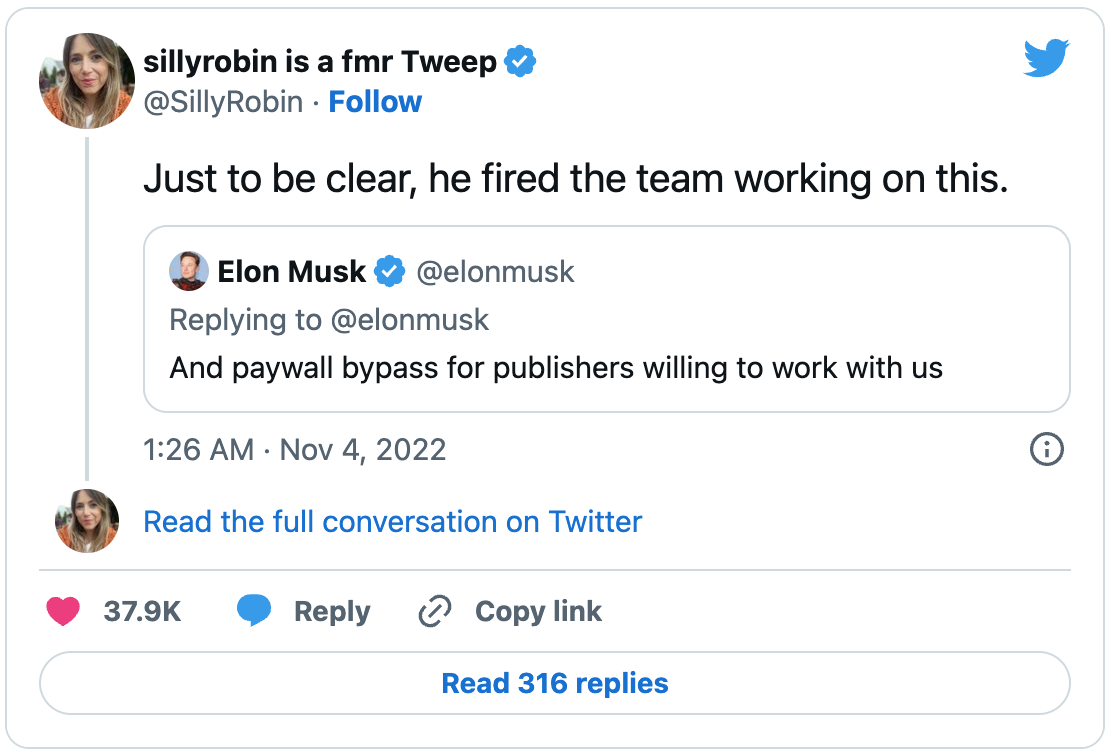
Source: Mashable
- An exodus of some of the company’s executives and biggest advertisers. It is important to note that this decision was influenced by a variety of factors, including brand concerns over Twitter’s general safety.
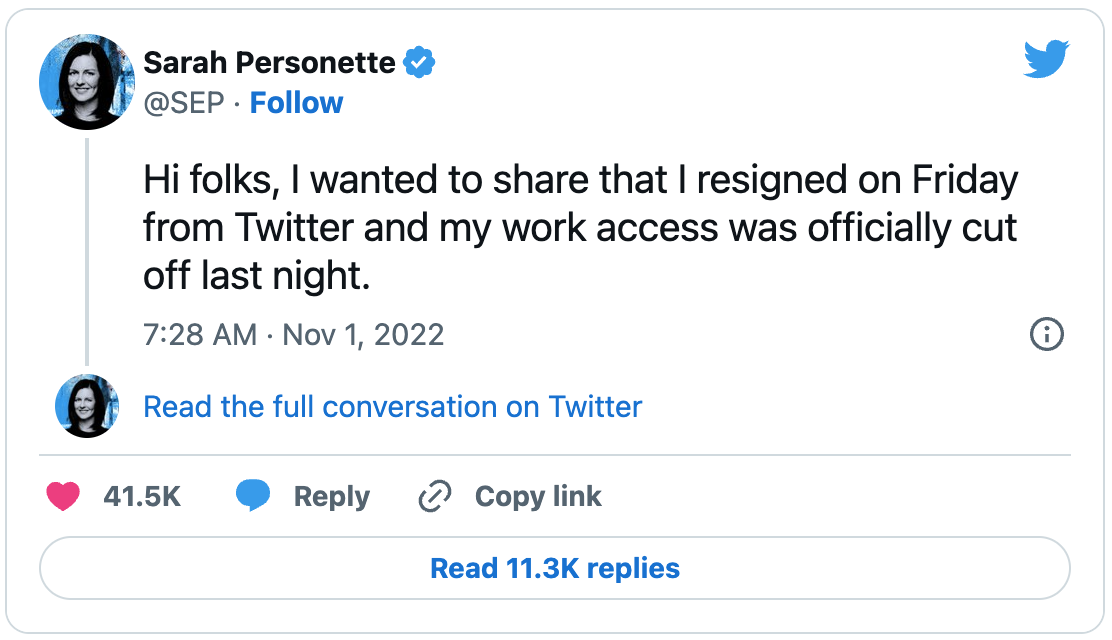
Source: New York Post
- And a class action lawsuit claiming that employees were not given enough notice under US federal law.
While Musk stated that there was “no choice” in the reduction of force when the company was losing over $4M/day—the lack of planning, clear communication, and compassion opened Twitter’s brand up to lasting reputational damage.
Like Twitter, other big tech companies have had to conduct layoffs and hiring freezes. Unlike Twitter, their plans were executed with much more precision and care.
Meta lays off 11,000 employees
Last week, Meta announced its biggest job cut yet, laying off more than 11,000 employees. Meta founder and CEO Mark Zuckerberg went on video call to thank employees and assume “full responsibility” for the situation.
Following the Wednesday message, employees lost access to company systems, although their emails remained active so that everyone could say farewell. Meta offered US workers 16 weeks (about 3 and a half months) of their base pay in severance and paid healthcare for 6 months.
Despite better planning, Meta did not come out of this reputationally unscathed. One ex-employee claimed that they were given no warning and were assured prior to the layoffs that their teams would not be affected. Another remarked that “Seemingly no contact was made or discussion from leadership with my manager of skip in terms of justification. Just a cold, impersonal email and then the plug is pulled before you wake up.”
Amazon is planning 10,000 job cuts
It was reported in The New York Times that Amazon will be laying off approximately 10,000 employees: namely in the company’s devices organization, retail division, and HR. Like Meta, Amazon hired optimistically during the pandemic and doubled its workforce. While it’s too soon to tell how Amazon will conduct these layoffs, it will be the largest one in the company’s history to-date.
Microsoft, Alphabet, and others plan to freeze (or slow down) hiring
While other big tech companies like Microsoft and Alphabet are not conducting big layoffs yet—they are slowing down ahead of economic uncertainty. After Microsoft reported its slowest revenue growth in five years last quarter, the company decided to pump the breaks on hiring. Alphabet, the parent company of Google and YouTube, announced that it will also be slowing down its hiring in Q4 after a 27 percent revenue decline YoY (Year Over Year).
What brands should do?
There is no easy way to lay people off, but some approaches are better than others. If your company engaged in overoptimistic post-pandemic hiring—and needs to backtrack—the first step is to plan a human-first approach. Can your reductions be conducted individually? Do you have a clear communication strategy? Be sure to answer the following questions thoroughly:
- Who is being let go?
- Why does the company need to go in this direction?
- How will employees be offboarded and compensated?
- How will top executives discuss the decision with stakeholders? How can that message be conveyed in a way that is compassionate and consistent?
This can be done in a host of ways, including a virtual event or webcast, paired with transparent and empathetic internal comms. The same level of consideration should be given to other company stakeholders, including investors, customers, and future jobseekers. Make sure that your plans for hiring and keeping talent are clearly communicated throughout your investor relations channels.
If you are going through a hiring freeze (as opposed to a reduction)—communicate that as well. Let prospective hires know what your future plans are clearly through your career site and social media channels. This way, you are ready to hire the best talent when the opportunity arises again.
Above all—lead with compassion. As we discussed in a recent blog, your company's reputation and future success relies on your ability to demonstrate corporate social responsibility.
Contact Investis Digital
At Investis Digital, we can help you build a talent strategy that works for your current demands AND future growth. Click here to learn more about our approach to HR & talent acquisition, or here to speak with one of our talent experts.