

Why Stakeholder Capitalism Matters to Your Business
Let’s talk about stakeholder capitalism and how you build your reputation. Especially in the United States, stakeholder capitalism is a thing. In fact, the National Investor Relations Institute just conducted an entire conference based on stakeholder capitalism. I was on the agenda, and Investis Digital was a sponsor. To be brutally honest, I don’t really use the term “stakeholder capitalism” much. I prefer “stakeholder value creation.” But language matters aside, the topic matters very much to me, my employer, and our own stakeholders. Does everyone know what it means, though, and why it matters to your reputation? Those and other questions arose from speakers and attendees during the NIRI event. I listened. And reflected. And now I’ll answer some of them.
What exactly is stakeholder capitalism?
Stakeholder capitalism means that companies seek long-term value creation by taking into account the needs of all their stakeholders, and society at large. That’s how the World Economic Forum (WEF) defines it. The definition is significant for what it does not say, too. Note that the WEF definition does not call out investors. They’re an implied set of stakeholders, but they’re not the sole focus of companies that practice stakeholder capitalism.
Stakeholder capitalism requires a company to undertake an important shift in thinking: from putting investors first to putting all stakeholders first, including people, clients, and the community (or communities) in which a business operates.
Stakeholder capitalism matters because employees, customers, and job seekers are holding businesses accountable for how well they balance the profit motive (typically seen as shareholder primacy) with the needs of people and the planet – the so-called triple bottom line. As McKinsey wrote, “Consumers and society at large are expecting more from business. Embracing those responsibilities can help shareholders, too.” This broader remit forces businesses to realize that pleasing shareholders alone is not going to be sufficient.
In addition, the rise of sustainability has made it painfully apparent that businesses that fail to look beyond the profit motive may not have a planet earth around much longer to do business in. No earth, no business, no profits. Game over. A concern over sustainability is not the sole reason why stakeholder capitalism has taken hold, but it is an important one.
For all these reasons, stakeholders want businesses to be more purpose-driven, meaning that they align their reason for being with the needs of society at large. Stakeholder capitalism makes a company’s purpose more purpose-driven.
A really good example of how an ethos of stakeholder capitalism can affect a company is the corporate attitude toward paying taxes. Companies that embrace stakeholder capitalism pay their taxes because taxes are about contributing to the communities in which they operate and generate profits. Businesses that seek every loophole to avoid paying taxes are putting profits ahead of people in their communities.
Stakeholder capitalism is more common in the United Kingdom than in the United States probably because in the UK, businesses need to fulfill regulatory requirements in areas such as sustainability, so it is common for companies to include commentary on stakeholder value in communiques such as their annual reports. But even though U.S. companies do not face the same level of regulatory scrutiny, some have done an exemplary job of embracing stakeholder capitalism.
Ford is one of them. Its Integrated Sustainability and Financial Report 2021 is a textbook case of discussing a company’s performance through the lens of stakeholder capitalism. The following excerpt is complicated, but take the time to review it closely:
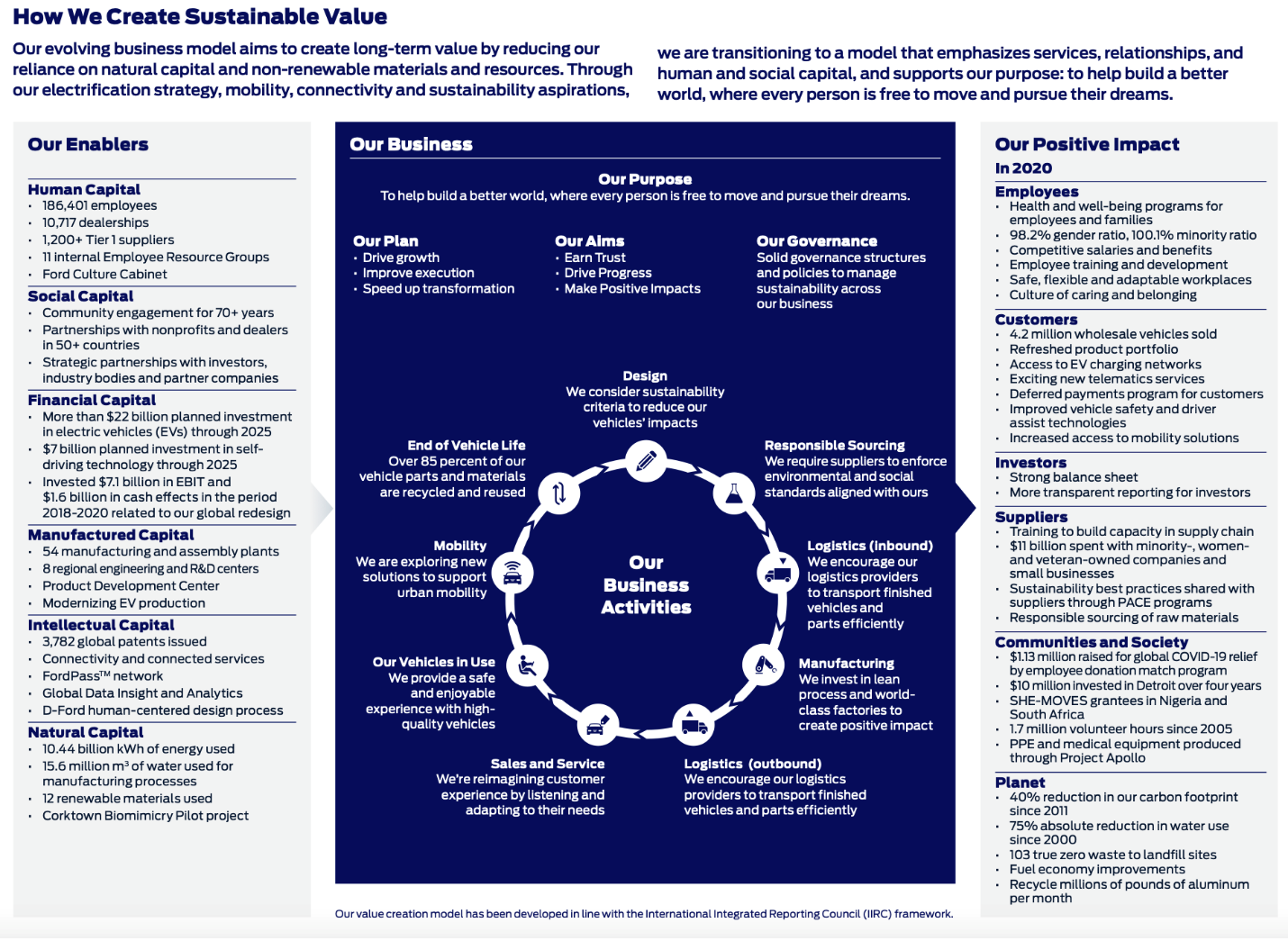
Notice how Ford describes its positive impact across the dimensions of employees, customers, investors, suppliers, community and society, and planet. Notice also that investors are not listed first. This is a vivid illustration of how a company views its value through its impact on multiple stakeholders. This kind of integrated reporting makes stakeholder capitalism real.
The term that I said I prefer – stakeholder value – is more commonly used in the UK. Value is about outcome. And businesses will always need to deliver value to stay in business no matter what they do.
If stakeholder capitalism makes a company’s purpose more purpose-driven, then what’s the difference between having a purpose and being purpose-driven?
A company’s purpose is why you exist. As Jane Okun Bomba, president of Saddle Ridge Consulting, said at the NIRI event, “Purpose answers one question: what would be the consequences if your company disappeared?” Being purpose-driven is about a business acting in a socially responsible way – to all its stakeholders and society at large. The two are not one and the same. A business can pursue a singular purpose of maximizing profit for its shareholders or creating the most exciting entertainment in the world without being purpose-driven. But the two are beginning to converge for the same reasons stakeholder capitalism is so topical: businesses are being held accountable for doing more than achieving impressive profit margins. Failing to be purpose-driven incurs enormous costs such as turning away purpose-driven consumers, investors, job seekers, and employees. Failing to be purpose-driven can alienate an entire generation too: the almighty Millennials, who will take a pay cut to work at a company whose values align with theirs. And guess what? Maximizing profit is not one of their strongest values.
I find companies are evolving into three camps:
- Those whose purpose is completely purpose-driven, too. These businesses don’t just want to align profit, people, and planet – they want to put planet and people first. A good example is Patagonia, which says the company is here to protect the earth. Ben and Jerry’s is another for its singular obsession with using its company as a platform to achieve social justice. Patagonias and Ben and Jerry’s are outliers, though.
- Businesses incorporating corporate social responsibility into their purpose, mission, values, and vision. Even if you don’t see “purpose-driven” ideas overtly stated in their purpose, you’ll find corporate social responsibility evident in some important element of their identity and reason for being. These are the businesses that balance people, profit, and planet, where companies such as Unilever, Ford, Vodafone, Coca-Cola are headed. Most businesses are on a journey to achieving this delicate balance. They know they are in business to make a profit, but they’re not going to make a decision that puts profit ahead of people and planet. Neither are they going to make a decision that puts planet and people ahead of profit.
- Businesses with no interest in being purpose-driven in any way. These are a rapidly disappearing lot, though. It’s hard to find a publicly traded business that gleefully avoids being purpose-driven especially as Millennials increasingly call the shots.
So, indeed, what would be the consequences if your company disappeared? Increasingly companies are answering that question by examining not only the monetary value they create but whether they are making the world better and improving the lives of people who call earth home.
If a company is living its purpose, how important is it to share it?
I’m glad one of my colleagues during a panel discussion asked this question. Articulating your purpose takes an effort, and then comes the arduous task of rallying your people and your board of directors around purpose – and judging from some pointed criticism made by Robert Eccles of the University of Oxford, most of them struggle to explain the purpose of the companies they advise.
I already noted that job seekers, in particular Millennials, are choosing purpose-driven companies. At a time when the war for talent is heating up, articulating a purpose, and demonstrating how you are purpose-driven, can make the difference between your winning or losing.
But even businesses that do not care about stakeholder capitalism and care foremost about investors still need to make sure they’re articulating their purpose – maybe even more so. In the marketplace, investors more than ever are focused on purpose-driven investing. And they’re looking at purpose as a performance indicator as evidence continues to mount that purpose-driven companies outperform those that are not.
So, how are you going to satisfy those investors as they look for evidence you are purpose driven? What evidence of being purpose-driven will they find when they visit your website and review your company’s Investor Relations section?
I would argue that we are at the point where demonstrating that your business is purpose-driven is table stakes for being a business, period. Investis Digital’s propriety evaluation of corporate website performance shows that most of them share their purpose, mission, and vision, even if few of them quantify them as well as they should. Discussing your purpose is akin to a company reporting its track record for profitability or client retention: why on earth wouldn’t you report those important metrics?
What’s next for stakeholder capitalism?
Much of the discussion about purpose in context of stakeholder capitalism has focused on protecting the earth. But some companies are looking at purpose as planet improvement, not just planet protection. Microsoft talks about being net carbon positive. Banks offer green financing to support clean energy projects. This is an encouraging development. In addition, the future of stakeholder capitalism includes measuring the value of purpose, not just articulating it. Businesses have a long journey ahead of them. Very few companies we study actually quantify the value of their purpose. But we’re living at a time when distrust of large businesses is high according to Edelman’s annual trust barometer. Metrics are not the antidote to mistrust, but they go a long way toward building credibility, and credibility begets trust.
All businesses will continue to be on a journey. None of them will act perfectly. None will have that perfect story of their purpose. But it is better to discuss what you have achieved and are doing rather than wait for the perfect time to tell that narrative. Those that don’t act will be left behind. Those that do will build trust.
Build Trust with Investis Digital
Investis digital creates Connected Content™ that builds powerful digital connections between you and your audiences. We do this by uniting compelling communications, intelligent digital experiences and performance marketing. To learn how we can help you build brand trust with the 4Rs, contact us here.