

Why Are Brands Struggling with Data Management in Commerce?
No matter how big your team is or how much online revenue your company pulls in, commerce executives are struggling to leverage the tools and data that they have in order to provide the best personalized customer experience. In fact, nearly 60 percent of enterprise companies say that they are failing in their efforts to become data driven. So, what can you do to stay afloat and not drown in your data pool?
1. Understand data has a lifespan
Enterprise brands have the benefit of collecting information such as customer information and buying patterns on a large scale. This is a blessing but can also be a curse if you do not sift through all the information you’re collecting. A study by Gartner found that the average cost of poor data in a business’s database can amount to anywhere between $9.7 million and $14.2 million annually. In total, that adds up to businesses spending nearly $3 trillion per year on hoarding bad data in the U.S. alone.
Some commerce giants may argue “the more the merrier,” but after a certain amount of time, the data you collect will be irrelevant. The risks of leaving contacts too long in your database can lead include inaccurate information and/or a changed interest in your product. How can you be certain that the contact you may have added years ago is still willing or ready to buy from you?
If you don’t feel comfortable hitting “delete” on these contacts quite yet, there are ways you can keep them in your system without standing in the way of your hunt for prospects. A few ways you can start organizing and managing your commerce contacts are:
- Determining a “cut-off” time - Don't let that old data fog your current data away to that cloud. Determine with your team what you’ll consider an active and inactive contact and what these timeframes will look like. These time reevaluations can be done as many times as each quarter or spread out to as much as once a year depending on your goals.
- Identifying reoccurring customers - Separating loyal customers with reoccurring purchases from your inactive customers.
- Organizing contacts by qualification - Storing contact based on “qualified” or “disqualified” labels.
Each contact realistically has an ideal timeframe to move forward and become a conversion. If a conversion is not done within that quota, it needs to be organized and put away. For commerce, this means staying vigilant in cleaning out your contacts. Your efforts will suffer greatly if a heavy contact list drags it down.
2. Be data-rich with direction
Data hoarding only feels right because as a digital marketer, you want to have a “just in case” backup. What if you start a campaign that requires that piece of data you are about to delete? The fact is, leaving these pieces of data alone can do more harm than good and add the real insights you want quick and efficient access to.
Even with data directly relevant to your field/company, you’re still not guaranteed any conversions or better insight just because you have a large database. It’s easy to see how a large intake of data can become overwhelming if you do not have the right plan in place to organize it. Brands are taking initiative by bringing forward the most helpful metrics that align with the company’s vision for a better future customer experience.
When in doubt, get together and realign with your team on which figures make the most sense for your business and database goals. You should always aim to narrow your data down to the most valuable insights you want to know about a contact. Make your data easy to access, leave no room for fluff and save your team from wasting valuable time collecting unnecessary facts and figures.
3. Cross-channel data
Most of the time, you’ll find a company’s data is fragmented between multiple departments. With all this data split between various teams, it’s common to see those teams use different platforms as well. For example, the core commerce team may use Adobe Analytics or Google while individuals on the team could also be using their own SEO tools that have even more data stored.
Take inventory of all the programs your company uses to decide how to organize it going forward. This means determining if you need a cross-platform analytics dashboard based on how many systems you and your team are using. Creating an all-in-one database means the platforms will be able to “talk” to each other and allows easy access and accurate reporting across all departments.
4. Have a clear omni-channel direction
A good commerce strategy can stand the test of time. The formula for commerce success doesn’t always have to be created from scratch. There are examples of large enterprise corporations to model after, like Walmart and Amazon, that prove large enterprise corporations can host, market, and sell thousands of goods and make a profit if done right.
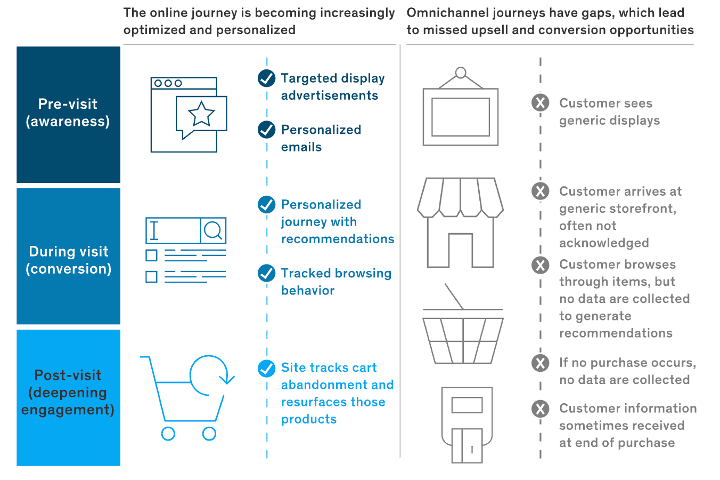
Among these wildly successful stories are also several businesses that fell flat in commerce and ended up closing their doors. At its peak, Sears had the potential to become Amazon. The wide variety of products and one-stop-shop atmosphere gained a cult following. But the company failed to organize myriad products online with a coherent value proposition and omnichannel approach.
Sears struggled to align fledgling online business with its instore experience. Having a robust digital shelf that matches up with an equally interactive in-store experience is key to exceeding a customer’s omnichannel commerce expectations. This means your physical shelf should be just as impressive as your digital shelf. Mending these gaps ensures that your customers can rely on your brand to take care of them from first touch to beyond the conversion; regardless of whether it’s done in-store or online.
How Investis Digital can help
We help clients analyze, organize, and prioritize valuable information in their databases. Click here to check out more of our commerce solutions & services or chat with an expert on how we can help you reach your commerce goals.