

Content & the Customer Experience
Some companies achieve phenomenal success with their digital marketing efforts. Others struggle to gain traffic and customers. When done correctly, you can grow your website traffic exponentially and not have to settle for incremental traffic boosts.
Digital marketing, content creation and SEO are not about guesswork. They are about planning, data, analysis, correlations, predetermined actions, A/B testing and engaging content.
Content and the Customer Experience
“Poor Content Execution Is Sinking Marketers’ Grand CX And Brand Visions,” is the title of an April 2021 report by Forrester Consulting Leadership study commissioned by Sitecore.
The report states that “Ad Hoc, One-off, and off-brand content execution” typifies “low-maturity brands.” Ouch.
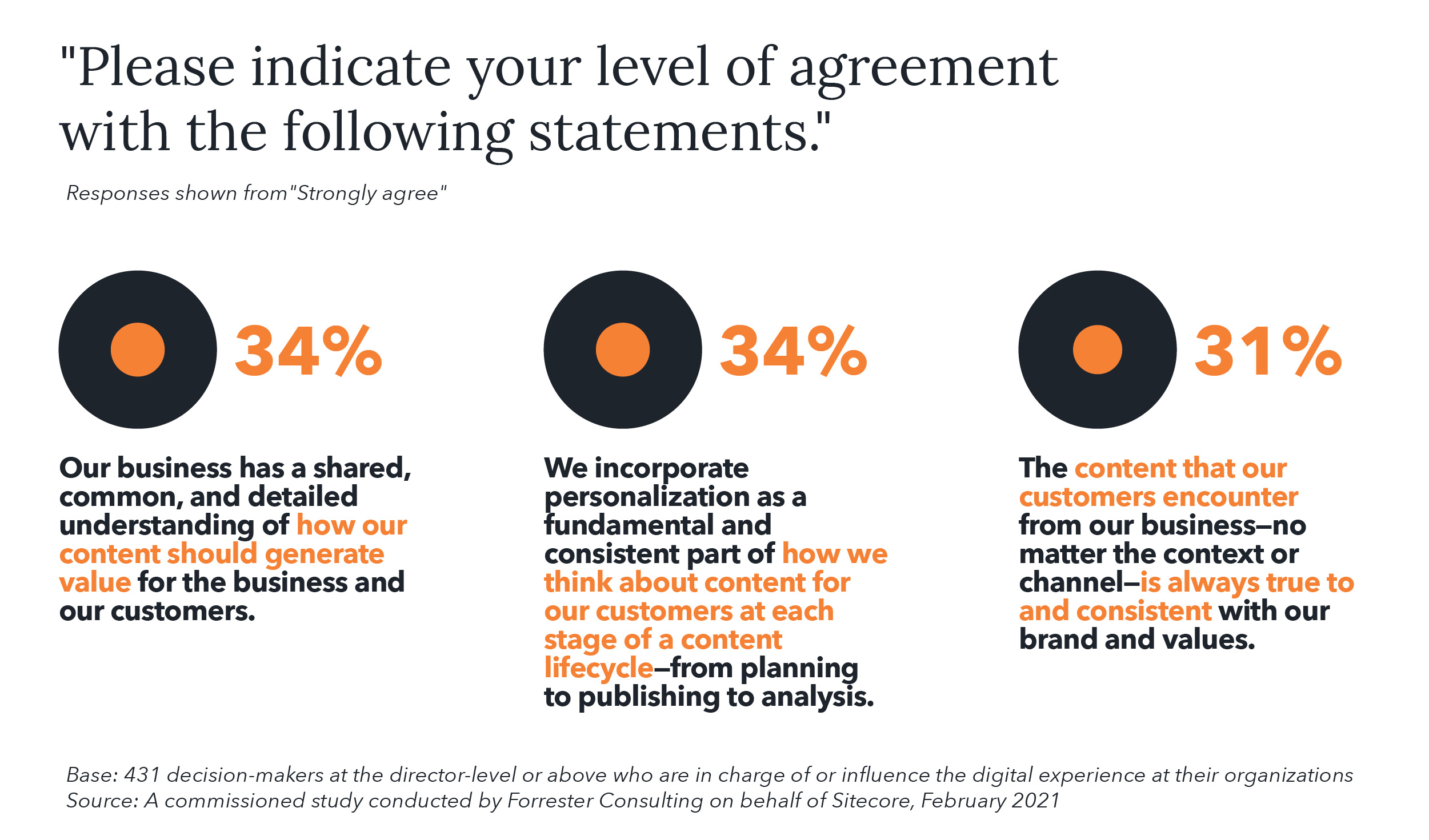
The Forrester-Sitecore report, derived from surveying 431 marketing leaders who are organizational digital marketing decision makers, reveals that:
- Companies impede the customer experience with too much ad hoc content. Content is created as a knee-jerk reaction to an event or only when deemed needed.
- Poorly planned and articulated content hinders the journey across digital channels.
- Disconnected content creation, planning and delivery was reported by an overwhelming majority.
- The majority of respondents said the right content-technology decisions as essential to their organizations’ success over the next decade.
Good Content Moves Prospects Toward Making a Decision
A key takeaway from the Forrester-Sitecore report is that businesses benefit from better planning, improved processes, better communication and better tools. Organizations should align their resources for content that moves prospects through the process of making a decision.
Assume you’ve implemented a digital marketing strategy. You have plenty of website traffic and a few more leads trickling in, but you aren’t closing the sale. This is a common struggle.
What’s happening? There’s probably a misalignment between your published content and how your prospects come to making a decision. Proper mapping content to your customers directly impacts the success of your digital marketing efforts.
You Need a Strategy
To achieve a successful digital marketing campaign, you’re going to need a good strategy. Without one, you are producing content just for content’s sake. No matter how clever you think it may be, your content won’t serve your business purpose.
One-offs, ad hoc and misaligned content does not inject value into your marketing efforts. Instead, they are random acts of marketing that are likely to stand in your way from becoming an authoritative voice in your business category.
Creating a Digital Marketing Strategy
The key to being successful is to create a strategy and align it with your business goals and how your customers make their buying decisions.
A digital marketing strategy is nothing more than a step-by-step, actionable process that aligns your resources and priorities with your business goals and strategic initiatives.
It takes a deliberate decision-making process that helps you align your resources with your expected outcomes. It should help you better define your audience, the appropriate content formats and channels to engage with it and how you will measure success.
Key Strategy Elements
Your strategy should be:
- Simple and clear
- Actionable
- Aligned with business goals and strategic initiative
- Communicated throughout the organization
- Defined processes and methods
- Hold people accountable
- Include KPIs and success metrics
Good Content Engages
1. Shift Focus From Selling to Audience Engagement
As in real life, the soft sell works better than the hard sell. You have to initiate trust. Begin that process by inviting visitors to engage with you. Offer them something of value: Answers to their questions in an editorial format, a newsletter subscription, an eBook.
Then, see if they raise a hand in interest. Only then can you move them through your strategic buying process.
This approach lowers resistance and enables you to organically collect their personal information through those downloads and subscriptions. Then, use this personal information to build your connected audience—one of your most valuable business assets.
2. Align Your Content and Resources With the Customer Touchpoints
To gain alignment, you need to understand the touch points that direct a prospect to a transaction. The decision making process is the sum of interactions a customer experiences with your brand on their path to purchase.
Understanding the stages of how your prospects decide on your products or services helps guide content direction for each stage. This helps ensure that your prospects engage and remain with your content and not that offered by a competitor.
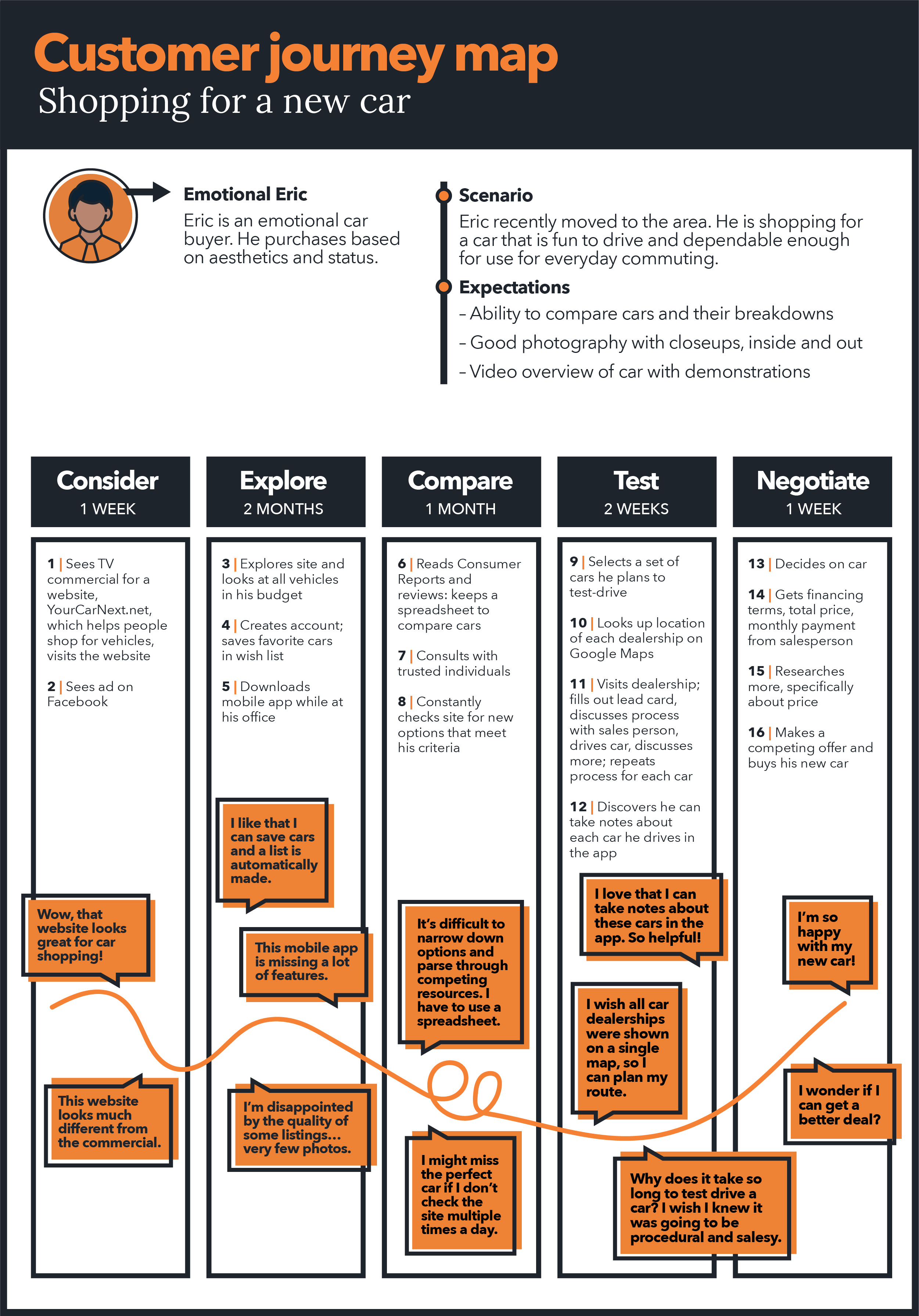
The decision making process is often called a customer journey. We do know that prospects go through a ‘process’ before buying. Understanding that the customer journey is not a linear...step by step process is very important. Prospects can engage with your content in any stage of their journey and in many different channels where they might find your information. It’s important to understand your customer journey but realize that prospects may take many more steps or they may skip steps. For example, the graphic below shows a journey to buying a car. You can see that it’s a pretty involved process but not everyone buys a car this way. In fact, my boss just bought a car. He decided one day that he wanted to buy a car and trade in his truck. He made a phone call, took his truck to the dealership and walked out with a car. He skipped most of the steps in the example below.
The takeaway is that the journey steps are important to know and align content with them but also that a prospect may circumvent all of them and go directly to purchase.
3. Develop Customer Personas
Who is your customer? You can’t lead them to the end goal if you don’t know who they are. You can’t speak to them if you don’t know what they fear and desire. You need to identify what motivates them to action.
You can create customer personas—fictitious representations of your prospective customers. Then, you can identify them by assigning descriptive names: Emotional Ernie, Big Bucks Barb, or whatever your team decides.
You can have several personas, each representing a market segment you want to target, not a specific individual. This can help you produce content that more accurately meets the needs of your audiences once you’ve identified your audience composition.
Up Close and Persona and Xtensio are tools you can use to develop and communicate your unique personas.
Four Benchmarks for Content Creation
There are four predictable types of content that you can create to align with your content strategy and business goals. They are:
- Awareness
- Consideration
- Decision
- Advocacy
Gaining understanding of each stage will help you develop a solid plan for moving customers through to a sale and advocacy for your brand.
Awareness Content
Awareness content focuses on the fact that your prospect is gathering information to learn about a problem, solve a problem or fulfill a need.
To determine what your customer is seeking, consider:
- How to start the conversation that shows your customer needs what you offer before they realize the need.
- What questions are customers asking about their needs or challenges
- How customers are currently educating themselves about these challenges
- How you can best provide resources for my customers that address their needs
- How to provide the best answers while building a trusted relationship with them
- How to spark enough interest in your product/service to move them to the consideration stage
Consideration Content
Consideration content focuses on the fact that prospects have a clearly defined problem, goal or challenge. They’re:
- Researching and evaluating their options before making a buying decision
- Relying on content that validates and solves their problem or helps them reach their goal
Prospects don't buy shovels, they buy holes. While explaining features and benefits is important, you also need to let the prospect know how your product or service solves their problems.
To determine how you can communicate solutions, identify:
- The type of solutions your customers are evaluating and how your solutions fit
- The type of content customers are consuming as they evaluate their options
- How your prospects evaluate the pros and cons of each solution to their challenge
- How your customers decide which solution is right for them
- What content will satisfy their research needs and move them to the decision phase
Decision Content
By now, your prospects have evaluated their options and identified your products/services as a viable option for solving their challenge. They’re deciding which product or service to purchase and will soon convert as a paying customer.
To determine what your customer is deciding, identify:
- Which qualifiers your customers use in evaluating their options
- What prospects like about your company when they are researching the options
- Any concerns prospects may have at this point that holds them back from commitment
- What the deal breakers are that might prompt them to move away from your content
- Your customer’s expectations
Advocacy Content
You’ve gained a new customer, advocate and a trusted partner by providing the right content, in the right format, in the right channel at the right time. Don’t stop now. Based on their success with your products, these new advocates will champion your brand and point others your way.
Nurture the relationship to ensure they’re repeat, long-term customers that advocate for you.
To determine how to advocate for your customer, identify:
- Who the advocate is and how their purchase decision relates to your current audience
- How the advocate influences others to consider your products
- Which questions the advocate can answer for your audience
- How you can promote testimonials that reach your wider audience
- Specific processes you can create to make it easier to champion your brand
Do You Have Content Gaps?
Look at the ratio of content you have published on your site relative to each of the four content types: Awareness, Consideration, Decision and Advocacy.
Most of our new clients have the highest percentage of content focused on the decision.. They have content that speaks to their products, physical address, hours of operation and contact info. That’s where it often ends.
Their content skipped right over the important types of content, awareness and consideration and jumped right into bed with decision.
That’s a content gap.
Avoiding the Content Gap
If you don’t have content focused in these four areas, you have a content gap. You’re kicking your prospect out of the car before they’ve reached their destination. Who do they call for a ride?
Your competitor.
Here are five things to consider when trying to identify which content type to include when prospects visit your site:
- What drives the prospect as they discover your business online?
- What is the real problem or desire they have that your product or service can solve?
- Why are you the best solution?
- How are you better than the competition? You need to clearly state why you are better.
- What are their doubts, objections and questions that need to be addressed before they move to buy?
Every content piece can be a business asset that drives traffic and revenue over time. Quality content that focuses on your customers’ needs creates trust and authority and positions your website for higher search engine rankings.
Building Digital Connections Around the World
Investis Digital creates Connected Content™ that builds powerful digital connections between you and your audiences. We do this by uniting compelling communications, intelligent digital experiences and performance marketing.
Investis has helped more than 1,600 global companies build deeper connections with audiences that drive business performance.
Investis Digital builds and runs intelligent websites and digital experiences that are rapidly deployed. They’re strategically measured and underpinned by secure, world-leading Connect.ID technology and 24/7 service.
We connect you with the audiences that matter most through powerful performance marketing solutions that optimize and amplify your brand across all touch points. Reach out to learn how we can help your brand.