

Five Indicators That Signal It's Time for a New Website
First impressions are everything and in this digital-first world, they are your calling card. And the first place your audience will go to understand your business is your website.
According to web credibility research from Stanford, 75% of users admit to making judgments about a company’s credibility based on their website. But oftentimes, the leap to a new website is one companies are hesitant to make. Still, with technology evolving at a rapid pace, it’s important to periodically ask yourself, do you need a new website? At IDX, we’ve broken it down into five indicators to let you know if it is time to have discussions about what the future looks like for your existing website.
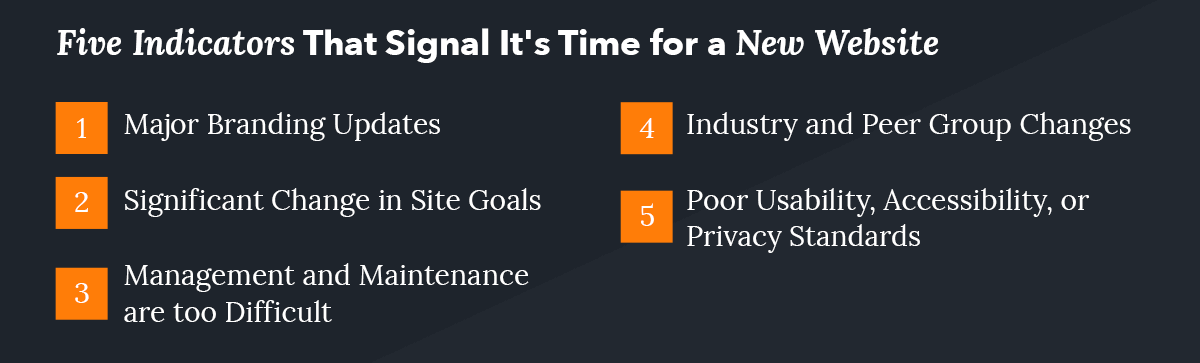
1. Major Branding Updates
A new rebranding initiative is one of the most common reasons to develop a new website. We’re not talking about updating a simple logo here – we are referring to a fully reconceived vision of your brand, including but not limited to new brand identity, messaging, experience and more.
This often equates to larger structural sites changes, in terms of both the sitemap (“Our Brand”-type pages) and page layouts themselves (e.g. new tone of voice and key messaging may require changes to the copy blocks, etc).
In the world of corporate websites, it is not uncommon for the parent site to initially roll-out a dramatic new branding and design, and often this needs to be also addressed throughout any child websites a corporation might have, such as Investor Relations sites, Careers sites, and more.
2. Significant Change in Site Goals
What does your website need to achieve? When planning a website, one of the first items to define are the website goals. These objectives serve as the critical foundation upon which the entirety of the site is built upon, and typically based on larger specific business objectives. Much of the planning, from architecture to functions and features, are built with a specific intent and purpose in order to align with those objectives.
And sometimes those objectives change. Small changes could potentially be handled with a variety of updates to an existing site. But more substantial changes may require more significant rework and planning – and this is when it may make sense to consider redeveloping from scratch.
Overall, as a rule of thumb, if a website is no longer meeting site objectives, it may be time to take another look.
3. Management and Maintenance are too Difficult
Over time, most websites grow. That means, more content and more features. And unfortunately, often more problems. New additions tend to be bolted on with a band-aid and tape, and after a few years the owners are left with a ‘frankenstein’ed website using bits and pieces from different hosts, platforms, code sets, templates, etc. And as any site architect knows, as the platform and code base begin to age, certain portions may no longer be supported.
At some point, this makes maintaining and managing the website prohibitively expensive in terms of time and resources. Site owners at this point may concede defeat and stop updating the website altogether, or only update the simplest items to keep some semblance of life.
Once this point is reached, site owners should strongly consider exploring options to redevelop from the ground up. At IDX, we know first-hand that as technology evolves, more options to create secure, flexible websites also become more readily available. These sites not only make an immediate difference but offer much more flexible maintenance options. In the long run, evolving a website now could not only save a company trouble, but enhance the ROI of its site long-term.
4. Industry and Peer Group Changes
Site owners at times become so focused on what’s happening internally that they forgot to occasionally look externally. It is good practice to periodically monitor the web estates of peers in your industry, as falling too far behind in terms of content, experience, or function can have significant impacts on your own site’s success.
Say you’ve got a nice, simple ‘Widgets’ product page that’s worked well enough for years, for example. It displays a text description, includes an image, and of course a price. Your closest competitor’s website (who sells the same widgets), rolls out some major updates. Now, they not only include everything your site has – but also downloadable spec sheets, video installation guides, searchable reviews from customers, live chat support, and more. The bar has been set much higher now, and website redevelopment may be required in order to compete.
5. Poor Usability, Accessibility, or Privacy Standards
In some cases, sites have simply aged to the point where their platform and design no longer reflect best industry practices of usability and accessibility. Is the site built to display appropriately on mobile and tablet devices as well as desktop? Does the site meet requirements for ADA compliance? Does it respect the rules and regulations relating to GDPR and CCPA?
As a site owner, it is important to keep your finger on the pulse of the web world, as new requirements, standards, and best practices are constantly developing. Falling further behind the curve makes the case for new site development stronger.
And of course, from a marketing standpoint, a salient question is always, are you proud of your website? More than ever, website audiences will want to know about the values a company holds at its core. If they see a misalignment between what is purported and what is enacted on a site, the company may miss valuable opportunities to connect with those they are trying to reach.
At IDX, we lead with data-informed insights, are proven by our award-winning creative, and leverage market-leading technology to deliver measurable results for companies around the globe. To learn more about how we’re transforming digital communications, get in touch today.