

How Apple Should Respond to #AppleToo
How Apple Should Respond to #AppleToo
It was recently reported that Apple fired a leader of the #AppleToo movement, which is an employee campaign to gather and share current and past employees’ reports of inequity, intimidation, and abuse. The dismissal of the employee is an internal issue that Apple is not going to comment on – nor should Apple feel compelled to do so. At the same time, the news coverage has raised awareness for #AppleToo, and in an unflattering light for Apple. How should Apple treat the increased visibility for #AppleToo? Here are some thoughts:
#AppleToo Gains a Foothold
On October 15, news outlets such as The Verge reported that Apple had fired an employee named Janneke Parrish. Why she was dismissed is unclear although Parrish has offered her own version to The Verge and to Reuters. Apple is not commenting. The story, though, has also cast attention on a movement inside Apple known as #AppleToo because Parrish was one of the leaders of #AppleToo.
According to the #AppleToo website, it is alleged that a culture of secrecy at Apple has allowed employee abuses to go unreported and unaddressed. In the words of #AppleToo:
For too long, Apple has evaded public scrutiny. The truth is that for many Apple workers -- a reality faced disproportionately by our Black, Indigenous, and other colleagues from minoritized racial, gender, and historically marginalized groups of people -- the culture of secrecy creates an opaque, intimidating fortress. When we press for accountability and redress to the persistent injustices we witness or experience in our workplace, we are faced with a pattern of isolation, degradation, and gaslighting.
To encourage a more transparent culture, #AppleToo is collecting information about employee wages; and collecting and sharing testimonials from employees alleging abusive behavior toward employees.
What Should Apple Do?
What should Apple do about the rise of #AppleToo and the unflattering information about the company emerging from the movement? In the short-term, interest in #AppleToo might subside:
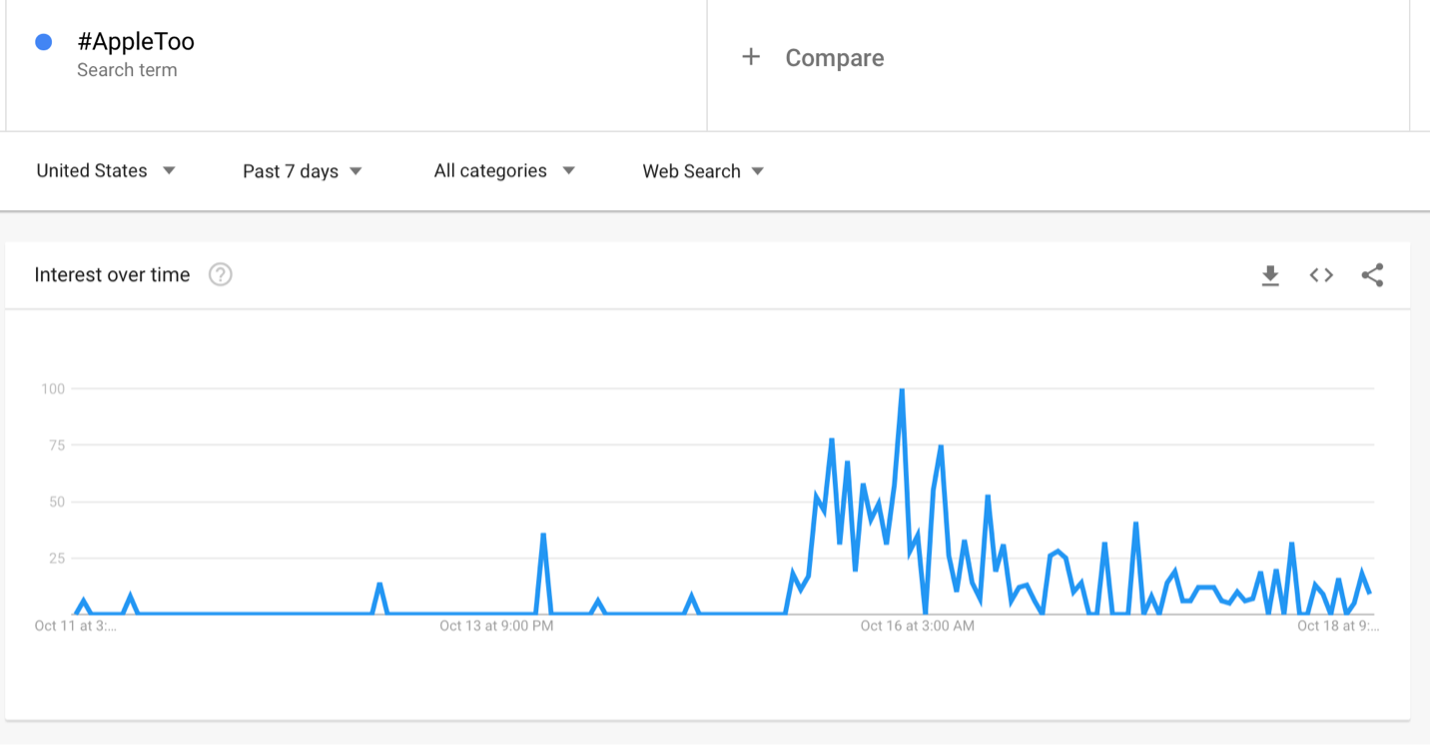
But in the long term, it might be wise for Apple to address #AppleToo – including why the movement was started.
How well a company tells its story around recruitment and retention is one of the hottest topics in the business world. This is especially true as corporations experience a spike in resignations. It’s all the more important that corporations align their public brand with their internal cultures. As we reported in our report Building Trust through the 4Rs: Responsibility, Reputation, Recruitment, and Reach, being empathetic to the well-being of employees is one of the most important topics in recruitment and retention. The pandemic has taken an enormous toll on the emotional and mental well-being of employees. They have dealt with multiple sources of stress: the possibility of catching the virus, the possibility of being furloughed or laid off, and life under extreme confinement (sometimes with children at home with schools closed) — to name just a few. The same holds true for future Gen Z job seekers, who have been scarred by a massive disruption to their college experience and face an uncertain job market.
According to Investis Digital Vice President of Strategic Growth Luke Bishop, “Employers are learning how to be more mindful to their people, and they need to talk about how they are doing that so that job seekers understand the progress they are making.”
How might Apple demonstrate empathy and responsiveness? A few ideas include:
- Take #AppleToo seriously. The existence of the movement is an employee signal. Even if the hashtag stops trending on social, the reason behind #AppleToo is probably not going away anytime soon: a segment of employees is feeling disenfranchised.
- At some point, Tim Cook will need to comment on #AppleToo. This does not necessarily mean he needs to respond to each employee testimonial collected by #AppleToo. But he’ll need to communicate that as CEO, he is listening carefully to what #AppleToo is saying and reporting. Most importantly, he needs to demonstrate empathy.
- Apple needs to double down on diversity and inclusion with its narrative. Earlier in 2021, Apple released a diversity and inclusion report. The report was chock full of data that demonstrates the strides Apple has made in diversity/inclusion. For example, Apple said that in 2020, the company filled 43 percent of open leadership roles and 29 percent of research and development roles with people from underrepresented communities. In addition, Apple filled 37 percent of open leadership roles by women in 2020. These numbers show transparency. Apple should keep these numbers in the public eye by amplifying them with performance marketing that includes paid/organic media.
- Apple should give more employees a platform to share their own stories. Apple has published brief written testimonials on its corporate site. But the company can do much more. For example, Apple should use video to make those testimonials more compelling. (Our own analysis of corporate websites shows that employee videos remain underutilized.) Testimonials will balance the numbers.
Bottom line: #AppleToo might seem like a headache for Apple management, but it’s also an opportunity for Apple to build trust through empathy.
To learn more about developing and implementing an effective employee recruitment/retention strategy read Building Trust through the 4Rs.
Contact Investis Digital
Investis Digital helps businesses build trust with all their audiences through an approach known as Connected Content, in which we align all aspects of a brand’s narrative with its values and culture. To learn more, contact us.