

Why Companies Need Data-Driven Storytelling
ESG investing has grown in popularity in recent years as investors look to put their money into more socially conscious companies. At the end of 2021, assets in ESG funds hit $2.74 trillion. And ESG is more than an investor issue: ESG is a hot-button topic for every audience and stakeholder of a business including employees, customers, investors, job seekers, and business partners. But publicly traded companies face an increasingly enormous challenge in sharing their ESG narrative.
ESG investing faces greater scrutiny
For one thing, the fundamental notion of “ESG investing” faces increased scrutiny. One reason: a lack of shared understanding of what exactly constitutes a company that practices ESG effectively. Case in point: two Citigroup stock analysts argued that weapons manufacturers and defense contractors should qualify as ESG investments because their products help defend democracy and preserve peace. Their assertion sparked controversy.
Another controversy: how exactly to measure a company’s commitment to ESG. Standards proliferate, and their accuracy is also called into question. For example, the S&P 500 caused an uproar when it dropped electric vehicle maker Tesla from its ESG Index as part of an annual update to the list. The controversy cast a spotlight on the credibility of ratings. But the ratings are not going away anytime soon. And publicly traded companies need to meet their requirements.
Different audiences, different expectations
As ESG becomes a motivating factor for multiple audiences, public firms must satisfy stakeholders with different expectations – as evidenced by the rise of stakeholder capitalism.
For instance, ESG issues are increasingly shaping investors’ priorities. But investors do not look at ESG from an altruistic perspective. They look at ESG from the perspective of risk. According to PwC, 79 percent of companies believe ESG risk is important, and climate change is one of the largest risks. According to that same PwC study:
- 75 percent of those same investor audiences agreed that companies should address ESG issues even if doing so reduces short-term profitability.
- 68 percent think ESG should be factored into executive compensation.
However, these same investor audiences are still focused on producing or procuring returns on their investment – so while the majority say ESG is important, only 49 percent are willing to divest in companies that aren’t taking sufficient action on ESG issues.
Job seekers, consumers, and employees view ESG as less of a risk factor and more of a matter of aligning a company’s beliefs and actions with its values. And they are willing to bypass job opportunities with businesses whose values align with theirs.
But even then, things get tricky. Social values permeate the consumer-brand conversation, but they do not always shape consumer action. According to Forrester, only 18 percent of consumers actually match their words with beliefs by doing business only with companies whose values align with theirs.
Data-driven storytelling
All this means businesses need to manage many moving parts to manage multiple expectations. They need to adhere to increasingly complicated reporting standards to meet investor needs, and they need to transparently share their ESG narrative through data-driven storytelling to consumers, job seekers, and employees typically from the CEO-level on down.
Why data-driven storytelling, though? Because at a time when it’s getting harder to measure ESG performance, audiences want, and need, corporations to step in and share metrics for what success means.
But data can be wonky and confusing. Corporations need to turn that performance data into a great story that resonates emotionally with investors, consumers, employees, and job seekers. Human beings are emotional creatures. Emotion creates a connection with a brand – investors included.
Data and storytelling need to go hand in hand. Storytelling without data puts a company at risk for greenwashing and incurring an unacceptable risk to their reputation. But raw data gets lost amid a sea of metrics dominating the ESG landscape.
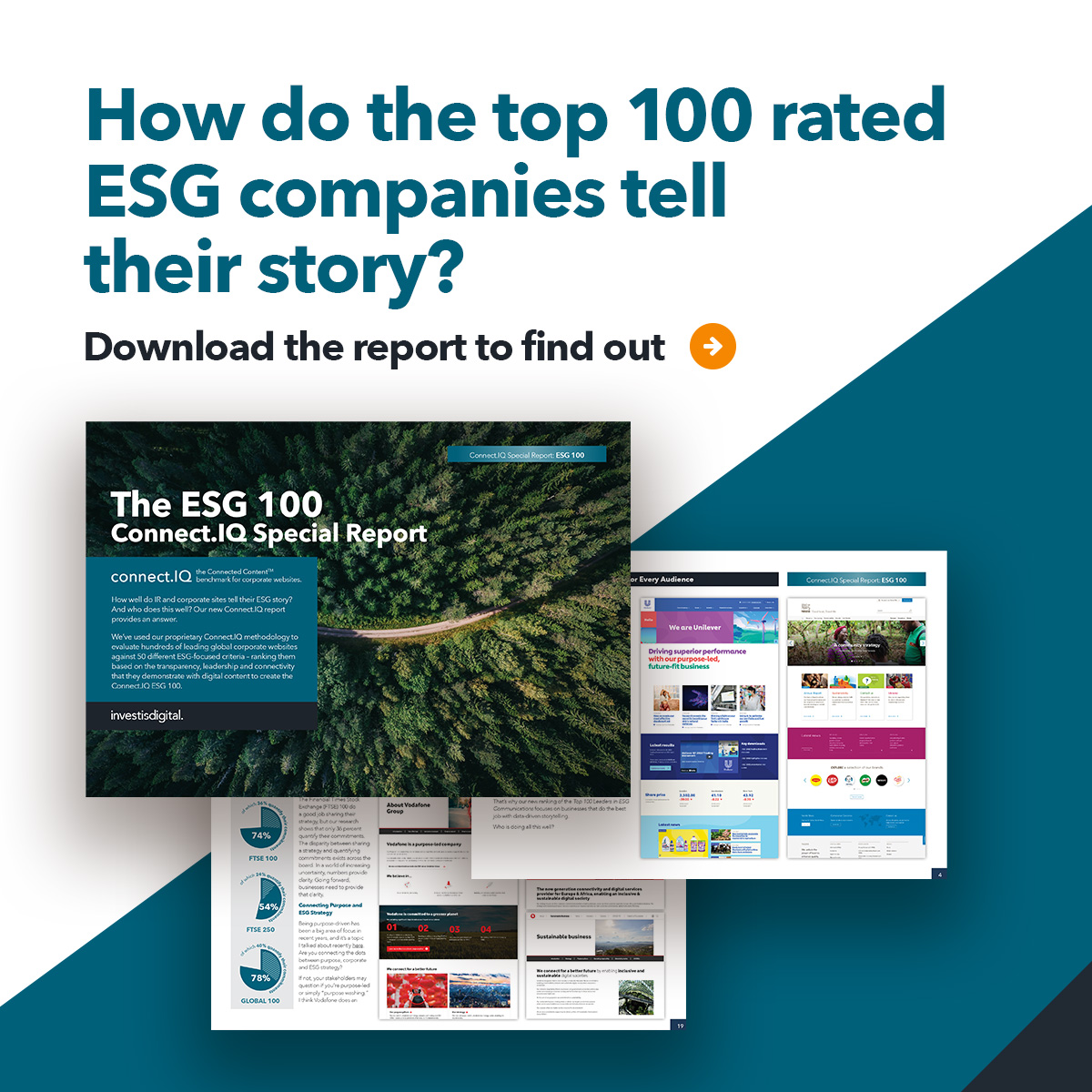
And do all of that not just once but on an ongoing basis. That’s why our new ranking of the Top 100 leaders in ESG communications focuses on businesses that do the best job with data-driven storytelling. Our newly published report provides insight into the companies that are using digital most effectively to share their ESG stories – and an ability to share credible, transparent data is key to their success.
We have used our proprietary Connect.IQ methodology to evaluate hundreds of leading global corporate and IR websites against 50 different ESG-focused criteria. From there, we have ranked the companies that use digital most effectively to build their ESG reputations.
Download the full report
Our ESG 100 report also provides a framework for sharing data-driven narratives that build trust with multiple audiences. To understand how companies are applying data to build their ESG reputations, please download our report.
Contact Investis Digital
Ready to upgrade your ESG narrative? Learn more about our ESG & Sustainability solutions or get in touch with one of our experts. We can help.