

Why Sustainability/ESG Matters More Than Ever
Remember when sustainability/ESG dominated the conversation about brand purpose?
Obviously, 2020 has changed things in ways no one could foresee. Businesses have radically changed their content to focus on the many ramifications of a global pandemic. A worldwide movement centered on social justice has caused many more businesses to rethink what they say and do. Seemingly, sustainability/ESG dominates fewer headlines.
But sustainability/ESG remains as important as ever. If anything, COVID-19 has underscored the need for a more sustainable future. The Yale Center for Environmental Law & Policy recently published the 2020 Environmental Performance Index (EPI), which provides a data-driven summary of the state of sustainability around the world. Using 32 performance indicators across 11 issue categories, the EPI ranks 180 countries on environmental health and ecosystem vitality. The Top 10 countries are all European. Some of the world’s largest economies outside Europe, though, including the China (ranked 120), India (ranked 168), and the United States (ranked 24) show plenty of room for improvement.
The authors of the study say that The COVID-19 pandemic has reminded us of the “profound interdependence of all nations and the importance of investing in resilience.”
Meanwhile, the World Economic Forum (WEF) has launched the Great Reset initiative to improve the state of the world. This is a commitment to “jointly and urgently build the foundations of our economic and social system for a more fair, sustainable and resilient future” according to the WEF website. The Great Reset will be the central theme of the January 2021 WEF Davos Summit. Before then, the WEF is hosting a number of virtual dialogues on a more sustainable future.
Klaus Schwab, Founder and Executive Chairman of the WEF, said, “We only have one planet and we know that climate change could be the next global disaster with even more dramatic consequences for humankind. We have to decarbonize the economy in the short window still remaining and bring our thinking and behaviour once more into harmony with nature.”
This is all well and good, but the primary burden on making the world more sustainable falls on businesses. Fortunately, many are taking action. For example, Amazon has announced its $2 billion Climate Pledge Fund to invest in sustainable technologies and services that will help the company reach its commitment to be net-zero carbon in its operations by 2040. The investment is the latest in a series of actions that the company has taken amid criticisms that Amazon has made the world less sustainable.
Amazon does something else: it talks about its sustainability/ESG commitment on its website, specifically here. If you Google “Amazon Corporate Website,” the company’s sustainability page appears prominently in search results, like so:
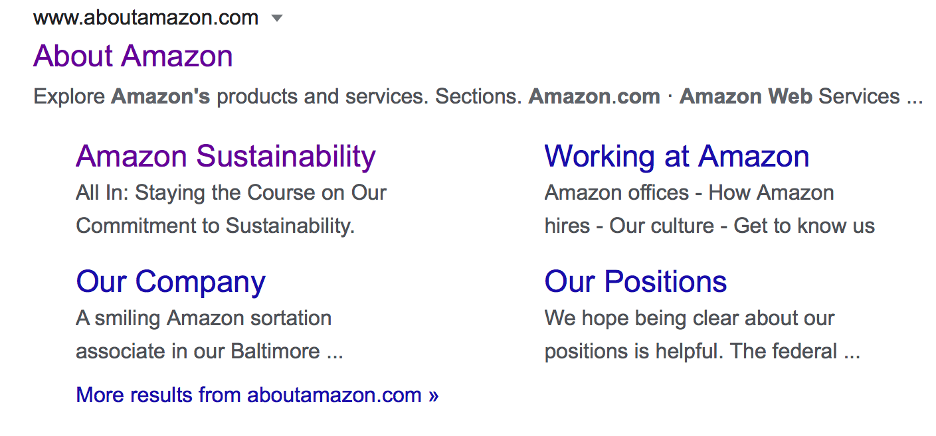
More businesses need to make a commitment to sustainability/ESG on their sites. Our newly published Connect.IQ report evaluates the effectiveness of corporate websites along several criteria, including how well they share their sustainability/ESG story. The analysis spanned corporate websites across major indexes like FTSE, NYSE, and NASDAQ. We found that:
- Only 29 percent of companies explain their sustainability strategy overall – and only 15 percent of the NASDAQ 100 (which includes Amazon) do so. Even fewer companies quantify it.
- 77 percent of the NASDAQ don’t talk about climate change.
Among the NASDAQ 100, the companies that do the best jobs with sustainability/ESG on their sites are Exelon, PepsiCo, and Microsoft.
Companies have a lot of work to do indeed, and they have a strong motivation: as we’ve shared on our blog, an increasing number of investors are using ESG factors to guide their investment decisions. According to the Connect.IQ report, board-level accountability for responsible investment grew from 34 percent in 2018 to 81 percent in 2020.
Especially as the swelling Gen Z population comes of age, sustainability/ESG will dominate the decisions that investors, job seekers, and consumers make. How is your business responding?