

Adapting Investor Relations in the Age of Acceleration
COVID-19 did not usher in a new normal for investor relations. Instead, the pandemic accelerated a change toward digital-first communication that was underway already. That was the theme of a December 3 virtual event, “Adapting Investor Relations in the Age of Acceleration,” conducted by the IR Society, Investis Digital, Vodafone Group (an Investis Digital client), and the Financial Reporting Council.
The event examined how IR professionals are embracing digital fully to engage with investors and humanize their corporate brands in some compelling ways, especially through video. Following are some highlights.
More of the Same – But Faster
Simon Gittings, Investis Digital creative director, shared context on the opportunity for publicly traded firms to elevate the role of the corporate website as a platform for reaching investors in a digital-first world. Of course, websites in and of themselves are not new, he noted. But in a digital-first world, IR professionals need to leverage their sites more effectively with an audience that expects content at digital speed.
For example, as investors accelerate their own uptake of digital, they expect companies to articulate their purpose, strategy, and value creation on their websites. But, according to an Investis Digital proprietary study of FTSE 350 corporate websites:
- Only three quarters of the FTSE 350 explain their strategies, and only 23 percent quantify their strategy.
- Only 42 percent of companies in the FTSE 350 make an effort to explain their business model. Just 12 percent provide any quantification.
- 47 percent of companies in the FTSE 100 define their purpose, but only 4 percent quantify purpose-driven ambitions. (Vodafone is one of the few.)
Clearly, businesses have a long way to go.
Investis Digital research also shows that more IR professionals are sharing their investment case by moving away from financials to a narrative based on capabilities and market fundamentals. One reason is that past financial performance is a murkier barometer of future success in a rapidly changing world. One way of sharing a narrative is to employ live events online.
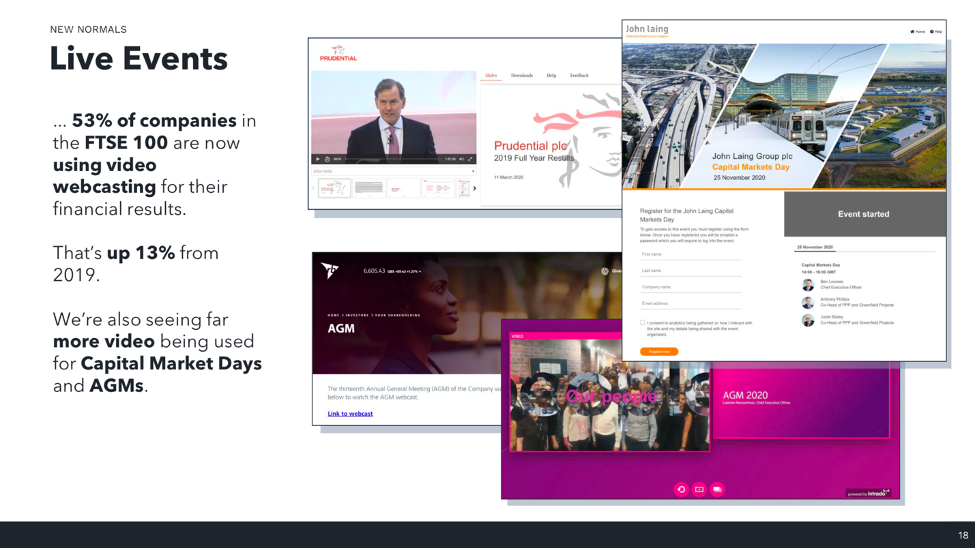
53% of companies in the FTSE 100 are now using video webcasting for their financial results, up 13% from 2019. Gittings said he’s also seeing far more video being used for capital market days and annual general meetings (AGMs).
In addition, 20% of FTSE 100 use film to share the story of how they are responding to COVID-19 even though lockdowns impose restrictions on production.
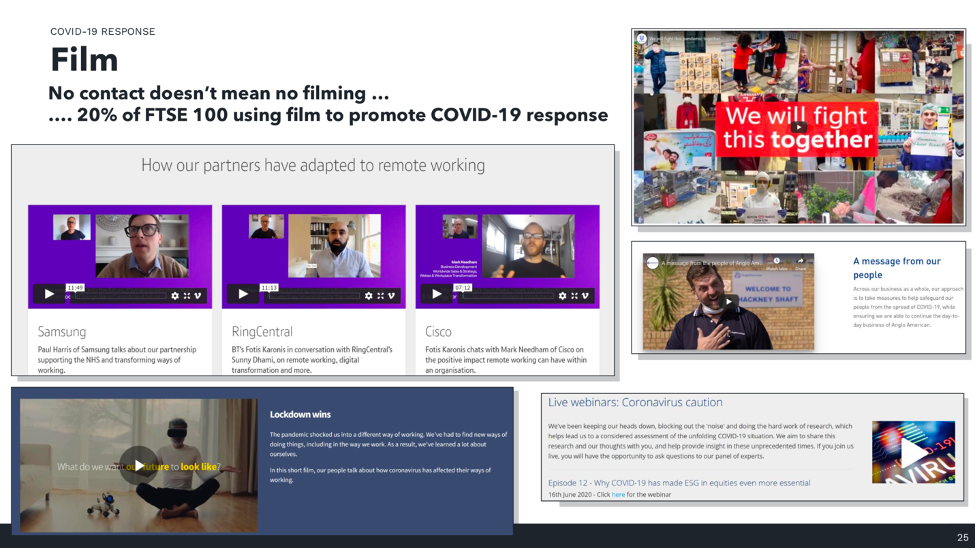
As Gittings pointed out, as we’ve embraced a Zoom culture, businesses are more comfortable empowering employees to participate in video narrative even though their production values might not be pristine. Authenticity is more important than perfection.
A Mindset Change at Vodafone
Matt Johnson, group investor relations director, Vodafone, shared how Vodafone has been embracing the rise of a digital-first world. He underscored the notion that the new normal was already arriving long before COVID-19. He noted that Vodafone is increasingly speaking to an audience that grew up in digital – Generation Zoom. This audience was expecting a digital-first experience for quite some time, and they are growing in numbers and influence. Vodafone was already responding to the rise of this digital-first audience by changing its mindset.
Under the old mindset, Vodafone relied on an omnichannel approach for reaching its audiences – a mix of online and offline events and heavy-duty annual reports. Digital was an online repository for data. But a digital-first mindset means that Vodafone treats digital as the primary channel for reaching its audiences. This means:
- Vodafone relies on data to identify its audiences and to deliver content faster and with more authority. For instance, IR professionals typically must explain metrics such as why a share price might fluctuate on a given day. Now Vodafone has detailed trading reports that can identify particular trades that influence share price. Data empowers Vodafone to get more detailed lead generation, too, including information about which institutional investors are on the site.
- The Vodafone website is an experience, not a data repository. The corporate website represents an investor’s first impression of the company. It must be interesting and inviting. And it must engage the visitor and encourage them to explore.
- Vodafone has also embraced digital first communications, for instance doing digital-only Q&As with the audience and delivering pre-recorded video to deliver a richer, high quality experience across time zones. This approach humanizes the company’s brand.
- Content is delivered more frequently. That’s because digital makes it possible to update investors. In a sense, Vodafone is being liberated from the confines of delivering content through a massive annual report. In a digital-first world, Vodafone can be more agile and engaging.
Video Defines the Narrative
Thomas Toomse-Smith, project director, Financial Reporting Council, took a closer look at how the FTSE 350 use video in sharing their narrative. According to Toomse-Smith, 86 percent of the FTSE 350 are using video to some extent. Typically they’re doing so to share news, deliver insight, to be aspirational, and to share a narrative:
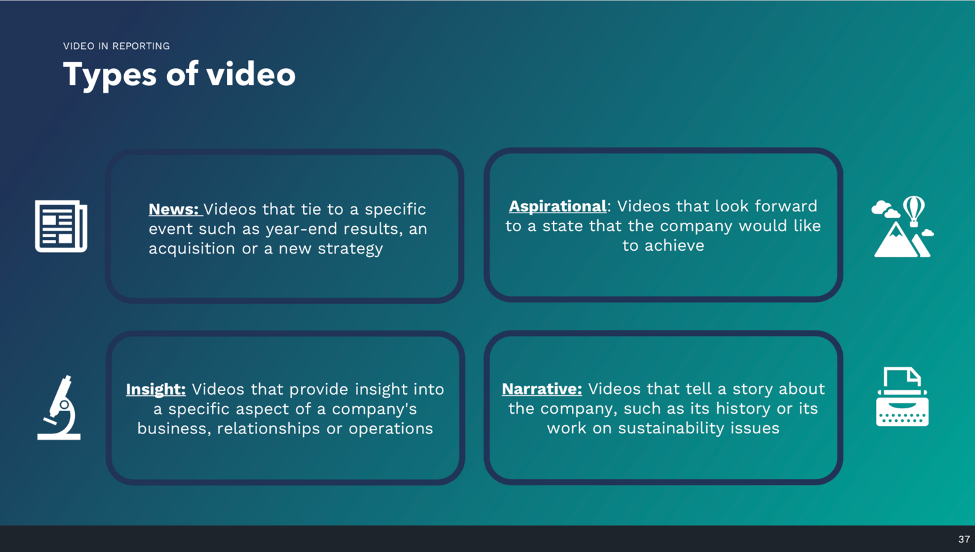
Video makes it possible to do these things with a human face. This is an increasingly important way to connect with younger generations of videos although it’s important that businesses be mindful to support the content with action.
The Financial Reporting Council also examined how well businesses are using video in big events such as AGMs. The number of companies producing a video or audio recordings of AGMs, or that allowed participation virtually, is low. Pre-COVID, the number across the sample was zero. Post-COVID this had increased to 10 (with five companies not yet having held a 2020 AGM. While there are potential barriers to online/digital-enabled AGMs they are not insurmountable — and therefore there is an opportunity to go beyond a physical-only approach to AGMs.
IR professionals can make a big difference in helping their companies succeed in a digital-first world by embracing video given the low adoption rates for AGMS in particular. Toomse-Smith shared some tips for how to do it right:
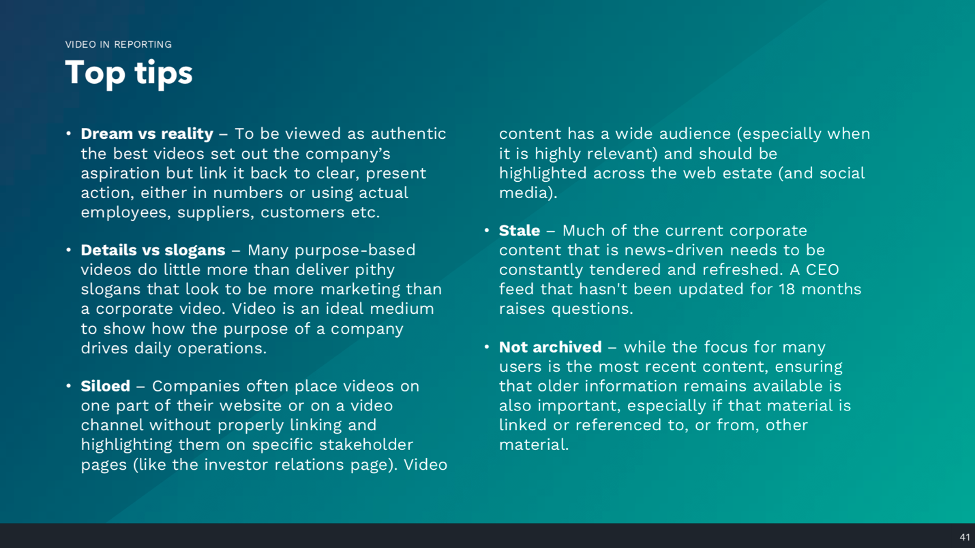
Bottom line: tell a compelling narrative to humanize your brand and engage with people online. But always back up your video with verifiable information. Don’t allow the narrative to take the place of facts. Make facts come alive with video.
For More Information The one-hour event covered a lot more ground than we are sharing here. To watch the entire presentation, register and watch it on demand. In addition, read our blog post, “How Investis Digital Shoots Corporate Video Onsite During the Pandemic,” by Mark Senior, head of film and motion design at Investis Digital. Contact us to learn more.