

How to Communicate with Investors When Your Stock Price is Slumping
During the great market sell-off of 2022, investor relations professionals everywhere are waking up each day to face the daunting task of communicating with investors. It’s certainly not easy. Publicly traded firms must restore investor confidence in their operations even as investors grow wary about a looming economic recession. Even if a business meets or exceeds its quarterly numbers, it still needs to manage investors’ expectations about the industries in which they operate.
This is certainly true of Netflix. For years, Netflix was considered to be the darling of the streaming industry. The company arguably founded the entertainment streaming industry and then changed it by shifting its model from hosting content to creating it. Investors rewarded the vision of CEO Reed Hastings for creating an upstart entertainment company. In 2021, Netflix’s stock price soared to an all-time high of $700 per share.
But in 2022, everything changed. In its first-quarter earnings announcement in April, Netflix stunned Wall Street analysts by recording its first loss of subscribers (200,000) and missing financial targets by a wide margin. The company’s stock price plunged to $175 per share. Netflix also projected that it would lose another 2 million subscribers in the second quarter.
Investors were spooked not only by the loss of subscribers but also by widespread speculation that the streaming industry was saturated. With so many competitors entering the market, ranging from Disney to Apple, investors worried that the streaming industry had run out of room to grow.
But months later, after its second-quarter announcement July 19, Netflix enjoyed a surge in its stock price – to be sure, nowhere near its 2021 peak, but a noticeable uptick.
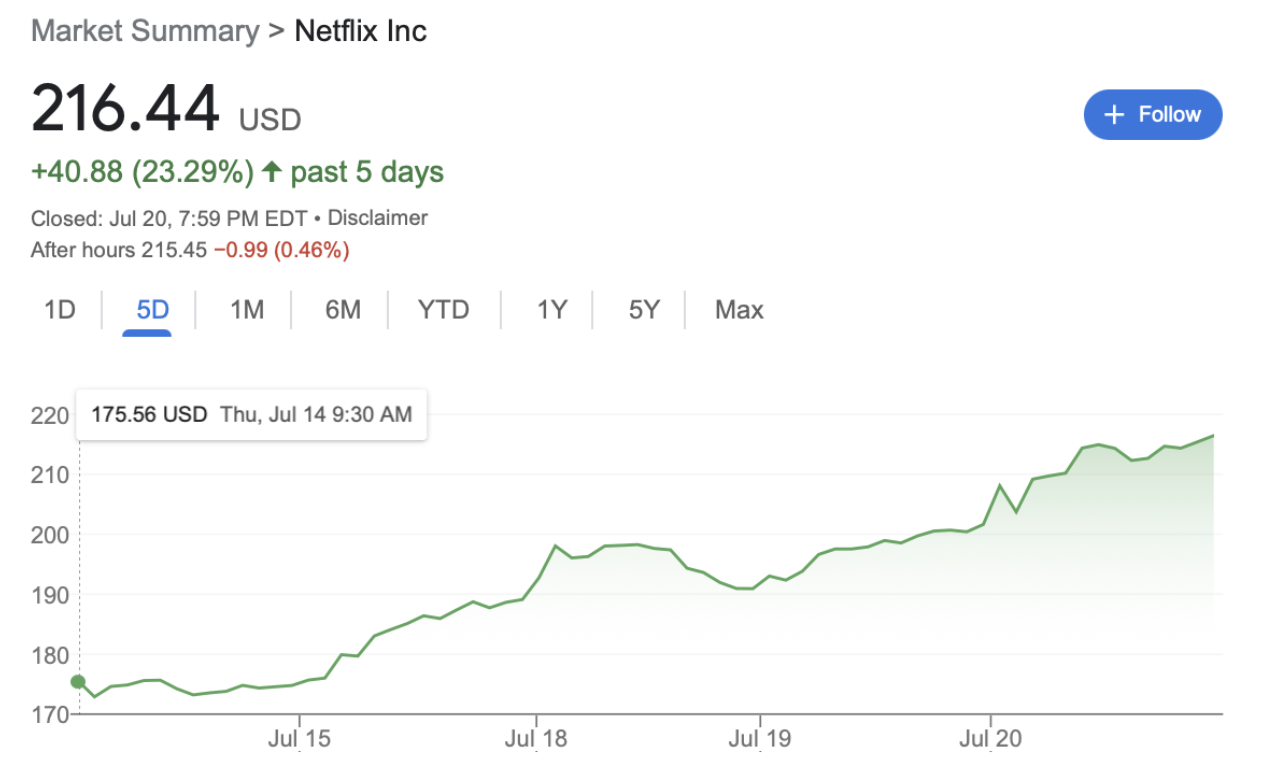
Why? Because Netflix is communicating a path to recovery and managing investor expectations.
First off, even though it was painful for Netflix to predict a loss of 2 million subscribers earlier in 2022, doing so managed investor expectations adroitly. In the company’s second-quarter announcement, Netflix announced a loss of 970,000 subscribers – not great, but far better than 2 million.
Second, Netflix has articulated a path to recovery:
- Adopting an advertising-supported subscription tier. After eschewing ads for years, Netflix saw the value of giving consumers a choice of paying less for an ad-supported model and more for an ad-free subscription. CEO Reed Hastings noted that the approach has worked for competitors such as Hulu, and he vowed to take action. Netflix is doing just that. The company recently announced that Microsoft will provide ad tech services to support the growth of Netflix’s ad tier. During its earnings announcement, Netflix also provided a 2023 timeline for rolling out advertising across different markets, taking a test-and-learn approach.
- Cracking down on password sharing. Netflix shared convincing numbers that cracking down on password sharing will help restore lost revenue. In its Q2 letter to investors, Netflix revealed a detailed plan for recouping revenue from 100 million households that don’t pay for a Netflix account.
- Creating great content. Netflix’s bread-and-butter growth engine consists of original programming. Netflix discussed for example how the hit series Stranger Things generated 1.3 billion hours viewed and had an enormous impact on popular culture. In the past, though, Netflix lived and died by content, and showcasing the success of a series like Stranger Things was geared toward future subscribers. But Netflix has a new audience to lure: advertisers. The company is certainly priming the pump.
Third, Netflix has exhibited a long-term vision. CEO Reed Hastings said that the end of linear TV is coming in five-to-10 years. This was a bold statement and a compelling one. Why would he do this? Because first, he wants to attract advertisers to connected TV, which is Netflix’s domain. And second, he’s addressing investors who might be fearful that streaming (which relies on connected TV) is saturated.
In its letter to shareholders Netflix wrote “in the U.S., which is one of the most competitive markets in the world, we drew more TV viewing time than any other outlet during the 2021-22 TV season nearly matching the combined total of the two most watched broadcast networks.” He added: “And, as Nielsen will announce on Thursday, our share of U.S. TV viewing reached an all-time high of 7.7% in June (vs. 6.6% in June 2021), demonstrating our ability to grow our engagement share as we continue to improve our service.”
In summary, Netflix is demonstrating how to communicate through hard times by:
- Managing expectations with credible metrics on company performance.
- Articulating a path to recovery and showing visible signs of implementing it.
- Sharing a vision for the industry as a whole.
These are all elements of good communications in general. But especially during lean times, it’s important that companies double down with metrics, a plan to recover, and a long-term vision. At Investis Digital, we help businesses build trust with investors through our own IR/comms practice. Contact us to learn how we can help you.