

The Role of Employees in ESG Investing
What is the role of the employee amid the rise of ESG investing? It turns out that employees may have a more important role than ever.
What is ESG investing?
ESG investing refers to environmental, social, and governance (ESG) approaches to investing in companies. For instance, ESG-minded investors take into account a company’s progress toward meeting specific goals for becoming net zero, which is important for protecting the environment. ESG investing is here to stay, too. More boards are designing ESG metrics for executive pay, and the Securities and Exchange Commission (SEC) is proposing new rules to promote consistent, comparable, and reliable information for investors concerning funds’ and advisers’ incorporation of ESG factors. All told, global sustainable fund assets reached $3.9 trillion in September 2021 and continue to grow.
Investors do not look at ESG from an altruistic perspective. They look at ESG from the perspective of risk. 79 percent of companies believe ESG risk is important, and climate change is one of the largest risks. To assess how well businesses manage the risk of ESG, investors are demanding consistent ESG data and narrative to support their investment decision-making.
The role of the employee amid ESG investing
Employees have an increasingly important role amid the rise of ESG investing.
For one thing, employees are also investors, and they’ll choose ESG-related investment options if offered through employers’ 401(k) or 401(b) plans. According to the Schroders 2021 U.S. Retirement Survey, of the employees for whom ESG-focused options were available, nine out of 10 chose to invest in them, and 69 percent said they would or might increase their overall contribution rate if ESG options were offered. But only 37 percent of 401(k) and 403(b) plan participants said they were offered ESG-related investment options. Employers would do well to be responsive to the investing needs of their own internal stakeholders.
Employees also act as an important voice in a company’s conversation about ESG. When employees perceive that the company’s public stance toward ESG is inconsistent with its values, employees will speak up – loudly and publicly, as a number of high-profile businesses have learned lately. Although it can be awkward when employees criticize their own employers for their commitment to ESG, they play a critical role in holding a company accountable for having an authentic commitment to ESG in a way that reflects their corporate values, argues Judy Samuelson, executive director, Aspen Institute Business & Society Program. As she wrote recently in Quartz:
Employees understand the customer, the cost of externalities, and whether intentions and execution are linked. They bridge internal and external pressures. They are allies in the long game, and they are not inclined to stay quiet when they witness back-tracking on public commitments and pronouncements on climate, or on human rights, or when the political action committee spends money to ensure access to a politician who is working against bedrock values.
She suggests that businesses tap into the voice of their employees as they shape their ESG investing narrative. At Investis Digital, we think of this process as building a narrative from the inside out. Here are two questions to ask as you create an ESG investing narrative:
- What do my employees believe about this topic? Gauging the sentiment of your own employees will uncover areas of internal alignment and possible disagreement. Even better, you may spark a conversation inside your organization about an important issue and the role of your company addressing it.
- Am I aligning investor relations with corporate comms? Have I vetted my IR messaging with employee comms and PR for consistency to guard against blind spots happening when our company talks to investors about its latest ESG-related initiative?
At Investis Digital, we recommend adopting a Connected Content approach, which means ensuring that the narrative is consistent across channels and audiences. We’ve applied Connected Content to help businesses develop credible IR communications including ESG-focused outreach.
Download our latest report
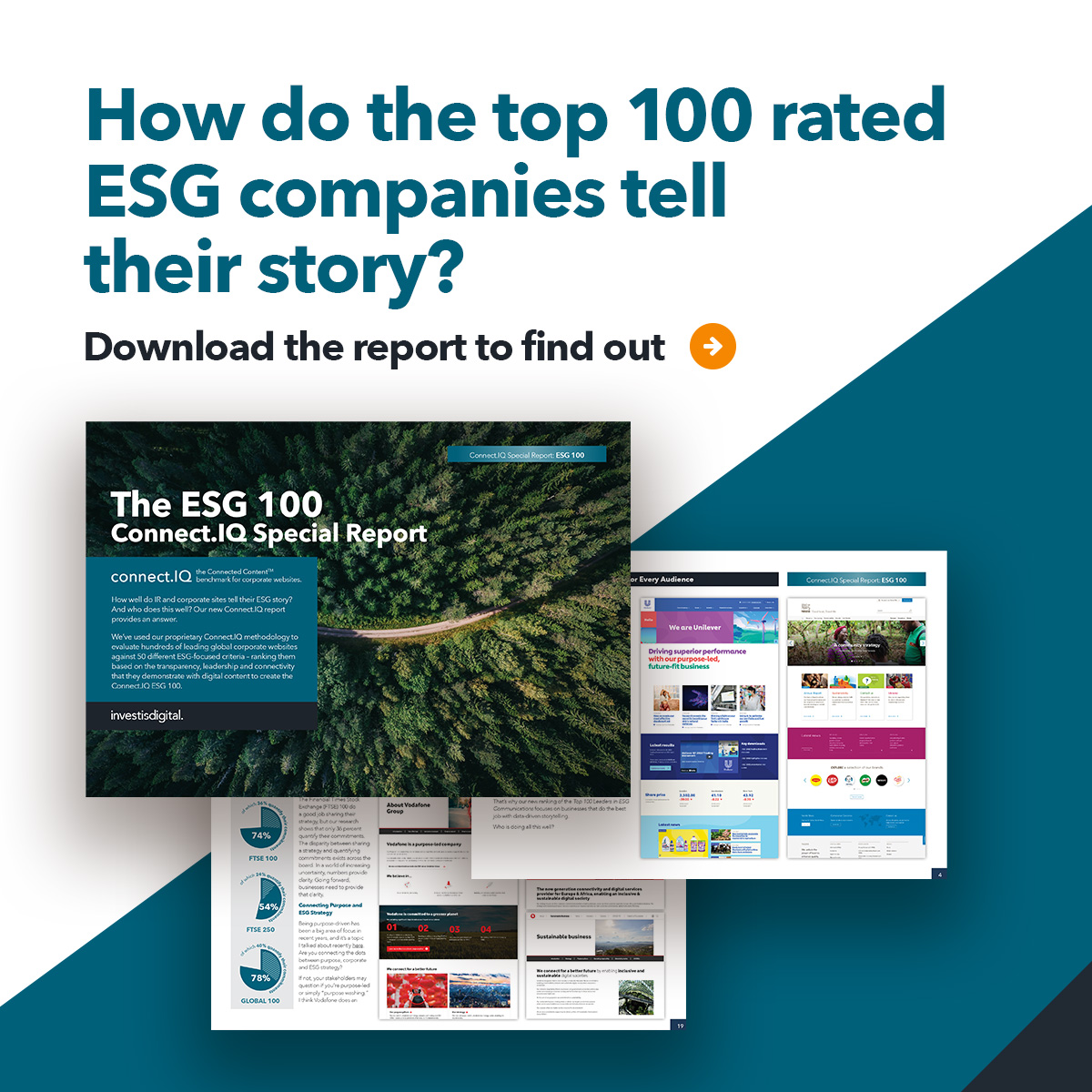
Learn more about our work in this area here and download our recently published white paper, The ESG 100, to find out who does this well and why.
Still have questions? Get in touch with one of our experts. We can help.