
5 Paid Media Trends You Should Know in 2018 (So You Don’t Fall Behind)
New year, new you… right? Well, ready or not, 2018 is here. And with it, comes a slew of new moves you should add to your paid media playbook to make sure you stay ahead of the competition.
Here are 5 Paid Media Trends to be aware of in 2018:
1. Intelligent Tracking Prevention
One of the most common mistakes when setting up Paid Media campaigns involves proper tracking. Having the perfect Campaign and Ad Group structure is pointless if you are unable to accurately measure your efforts.
Most recently, Google issued a clarion call to digital marketers everywhere to make sure all website tags are updated, due to the recent implementation of Intelligent Tracking Prevention. Google states, “Without updating your tags, it will be difficult to measure the efficacy of your marketing campaigns.”
Most notably, this will affect conversion measurement on Safari. To ensure accuracy, you may use any one of the following options to update your website tags:
- Install the global site tag (gtag.js) on your entire site
- Link your Google Analytics and AdWords accounts
- Use Google Tag Manager
Looking for more help? Review Google’s updated instructions to implement these options.
2. Full-Funnel Digital Strategies
It doesn’t matter how cool you think your products or services are, or what you believe people should read about… if your audience isn’t actively searching for that type of content, you’re already creating content gaps in the customer’s journey. Most of the time, success in content marketing has nothing to do with your writing skills, or how many longtail keyword phrases you can stuff into the copy. Great content depends on thoughtful ideation and actually answering your audience’s most common questions.
In 2018, companies are going above and beyond to provide a meaningful and relevant experience at every step of the customer’s journey. Introducing your brand on Facebook or LinkedIn, answering their questions with AdWords, or having a lead nurture campaign set up once they have downloaded your eBook are necessary elements in driving more qualified leads. Paid Media is not just being used to serve existing audiences, but to develop new ones as well.
3. Mobile, Mobile, & More Mobile
After the initial blast of smartphone production over a decade ago, mobile content fundamentally changed. Within a few years, everything that could be viewed – or optimized for a mobile device – became extremely valuable for marketers. According to research from eMarketer, time spent per day on mobile increased by 7 minutes, reaching a total 3 hours and 15 minutes per day from 2016 to 2017. And those trends are going to continue this year. Consumers spend more time than ever on mobile devices, whether that’s by smartphones, tablets or Internet of Things.
Here are a few statistics that show why mobile should be a focus of any paid media strategy in 2018:
- By 2019, #mobile advertising is expected to represent 72% of all U.S. #digital ad spending.
- 68% of companies have integrated #mobile #marketing into their overall marketing strategy.
- Average smartphone conversion rates are up 64% compared to the average desktop #conversion rates.
- Websites that load in 5 seconds on #mobile see 25% more ad visibility and 70% longer session duration.
Want more eye-opening stats on mobile marketing? Check out Impact’s 38 Mobile Marketing Statistics to Help Your Plan for 2018.
4. Incrementality Focused KPI’s
For Investis Digital, incrementality represents how much a marketing campaign or channel contributed to increased sales revenue. Focusing only on direct ROI of ad campaigns can lead to inaccurate conclusions when determining which efforts are delivering the most value. Typically, Return on Ad Spend (ROAS) is the KPI used to measure the cost-effectiveness. But, there are two main reasons why this focus is considered incomplete:
- ROAS does not consider incrementality, which in turn incentivizes the practice of turning on retargeting or brand campaigns to meet goals while hardly generating any tangible results.
- It produces incentives to sell more low-margin products to mainly existing customers because this type of second-rate revenue is cheaper to get.
This is one of the reasons why companies become stagnant and their competitors easily outgrow them. Some businesses focus strictly on ROAS and forget about incrementality.
In 2018, it will be imperative that companies focus on the incrementality of their campaigns, or what revenue they wouldn't have already captured without the presence of the ad. It is this incrementality that helps truly determine which campaigns are really finding net new business and pushing the needle. Investing in incrementality is the way of the future.
Need more info about incrementality efforts? See how the vicious cycle of ROAS targets might be killing your business.
5. New AdWords Interface
If you haven’t noticed yet, AdWords has been pushing users to take a crack at their new interface. A beta version can be found at the bottom right corner of your screen in AdWords.
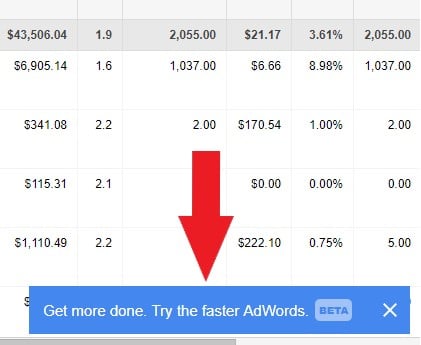
If you haven’t already done so, now is a good time to give the new interface a try. Nobody knows if, or when, Google will make all users switch to the new interface. But in any event, it offers unique features that won’t be found in the current version. Some of these features include:
- Promotion Extensions: These extensions let you show and link to any offer you may have within the text ads.
- Household Income Targeting for Search: In the new interface this type of targeting is easily accessible from the Demographics tab and allow you to quickly see how your campaigns are performing across different household income segments.
- Audiences Page: This is a new page which allows you to oversee targeting and optimizations from one location.
Aside from these new features, navigation within the new interface is quite different, as well. So, the sooner you roll up those sleeves and give it a try, the better. Don’t get left in the dust by Google if they decide to do away with the current interface this year. When it comes to staying ahead of the curve this year, be sure you incorporate each of these items in your overall paid media strategy. For where there is no change, there is no progress.