

Gated vs. Non-Gated Content: Why, How and When?
To gate or not to gate, that is the question. It’s a common dilemma for marketers today: do the pros of gating premium content outweigh the cons of asking for personal information from your visitors? We’ll offer an answer to this great gate debate, and provide the know-how to implement your own gated content to drive more traffic, leads and revenue for your business.
What is Gated Content?
Gated content is any media that’s placed behind a lead capture form. In other words, a user must provide personal information in order to access the content — typically an email address, phone number, or answer to a low-friction question.
For example, IDX uses a “gate” or lead capture form in front of several digital communications resources:
You’ll notice that majority of this content is 10x, premium content that provides direct value depending on our audience’s needs. Along with providing a resource for them, gated content allows us to gather qualified leads by asking for more information about our readers – whether that’s an email address, your name, title, company, email phone number, etc.
While few publishers (I’m looking at you Harvard Business Journal) limit access to everyday content by requiring a subscription or newsletter signup, many of them only gate premium content like eBooks or other forms of 10x content.
Gated Content Examples:
- Contests
- Templates or Tools
- Checklists
- eBooks
- White Papers
- Webinars
- Training Videos
Non-Gated Content Examples:
- Articles/Blog Posts
- Curated Content
- Infographics
- Lists
- Visuals (images, GOFs, mems)
- Press Releases
- Testimonials
- Snippets
Why Use Gated Content vs. Non-Gated Content?
Marketers just can’t seem to agree on whether to use gated or non-gated content – and this is for good reason. We have trusted experts and industry leaders at both sides of the spectrum; on one side, marketers believe that the pros of gaining qualified leads outweigh the con of turning away potential visitors. On the other side, it’s believed that by asking for their personal information, you’re losing potential reach of your content, SEO value and link opportunity.
The Gated Content Debate
This debate can actually be narrowed down to a single question: Are you interested in generating page views or qualified leads? Want to see two really smart marketers throw down for a gated vs. non-gated content debate? Check it out, here.
Our “pro-gaters” will most likely agree with Mike Volpe’s philosophy:
“If I can get 100,000 people to see that page and I can get 28,000 people to fill it out, 28,000 contacts may be more valuable than even 50,000 people seeing the content.”
While our “anti-gaters” might lean toward David Meerman Scott’s viewpoint:
A lot of people will see the form and say, ‘Forget it. I don’t want to fill out the form.’ The vast majority of people are unwilling to share a piece of content that has a form in front of it. A lot fewer people will blog and tweet something that has a form on it.”
Let’s look at both arguments…
Benefits of Gating Content
Pretend you’re really interested in learning more about Search Engine Optimization (SEO). As you scroll through your Twitter feed, you notice that a great post on the future of SEO trends written by IDX.
This post is exactly what you’re looking for, but before you can get the free guide, you must provide the following information:
- First/last name
- Company name
- Job title
You’re benefited by gaining access to this 10x content, while IDX is benefited by getting to know you a little better (and offering more closely-related content to you in the future). Think about your own company, and the advantages you could gain by gating high-quality content:
- Understand your audience better: By gathering more details about who specifically accessed the content, you can accurately target and nurture those leads in the future.
- Forge a trusting relationship: Those who invest in gated content by providing their own information might view it as being more valuable, thus establishing your brand as trustworthy and authoritative.
- Streamline your sales process: Conducting outreach to those who accessed your gated content is much more effective because you have more qualifying information about them.
Drawbacks of Gating Content
It wouldn’t be a fair debate unless both sides are heard. Let's talk about the potential drawbacks of gating content:
- You might reach a limited audience: It’s a bit harder to get gated content in front of your entire audience, unless you put serious effort and budget behind promotion. Depending on your industry and audience needs, it can be difficult to get a large part of your audience to fill out the gated form.
- It can be harder to earn links: Your audience will typically avoid linking to a gated landing page. This makes sense, though. Many people will skip sharing gated content because their audience isn’t ready to give up their information to your (or another) brand.
- Some readers might be turned away: Let’s face it, gated content can leave a bad taste in the audience’s mouth if they’re targeted at the wrong stage of the customer’s journey. This can result in a negative brand perception or loss of trust.
Ending the Gated vs. Non-Gated Debate
Despite the long-winded debates between marketers, the answer is pretty simple: Gating the wrong content at the wrong time during your customer’s journey can discourage potential clients from continued engagement with your brand. However, gating the right content at the right time can help you nurture budding leads, while supporting a trusting relationship and potentially boosting revenue down the road. Consider this easy formula from Rand Fishkin:
"If audience size, reach, and future marketing benefits are greater than detailed leads as a metric or as a value, then you should [provide] open access [content]. If the reverse is true, if detailed leads are more valuable to you than the audience size, the potential reach, the amplification and link … then you should go with a gated model."
How is Gated Content Used?
We’ve established that brands utilize gated content to generate leads that can be nurtured and (hopefully) turned into new business. But, how can you effectively use gated content to drive as many leads as possible without losing traffic to your website? IDX implements gated content along with our Hub & Spoke content marketing strategy.
The Hub & Spoke Model
With the Hub & Spoke Model, you’ll research, produce and publish a main piece of content (the hub), and then create many smaller pieces of content (the spokes) that relate back to that significant piece of content.
Typically, the hub is gated behind a lead capture form, because it offers the most robust value to the audience. The content is rich and high quality. It’s a piece of content that a user would be happy to trade their email address for. The spokes are published to drive all traffic to the hub (while moving your audience along the customer’s journey).
The hub and spokes are tied together. Without a hub, the spokes would just be miscellaneous pieces of content and not tied to any specific content marketing goals or strategy. Think of this model as an image or illustration:

The hub is located at the center and the spokes are all connected to the hub, just like a wagon wheel. As the wheel rolls forward, it gains traction and moves traffic along the spokes directly to the hub.
Creating Highly-Effective Landing Pages
Creating effective landing pages is essential for any gated content. A solid landing page is the best way to lower bounce rates, and get people to exchange their personal information for the content while building your email list.
Here are a few key attributes of an effective landing page:
- Page immediately establishes a “need” for the audience. In other words, it entices the reader to provide basic information and access the content.
- Expectations are clear. The landing page doesn’t utilize any bait-and-switch techniques. The reader has a full understanding of what they can expect from the content.
- The lead capture form is clear and easy to locate. It asks for low-friction information (name, email, company name and position).
- Call to action is bold and clear
Crafting a Thank You Page
Thank You Pages (often called, “Confirmation Pages”) are an overlooked, yet extremely valuable page for any website. It’s another great way to “seal the deal” with your audience.
Think about it this way, visitors to your Thank You Page are the next closest thing to a paying customer. Since they’ve already decided to take the next step along your customer’s journey and provided their personal information, these are leads you cannot ignore.
If your website converts at 5%, (this means only 5/100 of your site visitors even make it to a thank you page), then the visitors who do make it there should be taken seriously! Thank You Pages might look different depending on how you decide to deliver the gated content. For example, you might thank the reader for downloading the gated content, or confirm that an email will be sent to the provided email address with the content. Here are some best practices to consider:
- Say thanks: Let your visitor know that they completed the form correctly and you’re happy that they did. If it’s appropriate (maybe they downloaded your latest eBook), congratulate them!
- Set proper expectations: Tell them what will happen next. Surprises can be fun in life but generally are bad for business. Setting expectations is critical in all aspects of business, and this is a great place to set proper expectations and then work with your sales team to ensure this initial expectation is exceeded. Quick, little wins can go a long way at the beginning of relationships.
- Provide clear next steps: A typical next step might involve your sales team reaching out to the newly acquired lead. But it doesn’t have to be this way! If this is a prospect that is ready to move forward and timeliness is important, provide them with an easy way to take the next steps themselves. Otherwise, nurture the lead further, and provide even more awesome content for them in your email.
- Set the right tone: As your audience flows through your site and continues their customer journey, setting a consistent tone is just as important as setting proper “next step” expectations. Sending the wrong signals at this stage can be detrimental to your sales team’s contact rates, especially if your business is very serious and the thank you page sets an unprofessional tone.
When Should I Implement Gated Content?
Successfully mapping your gated content (along with the Hub & Spoke Model) based on your client’s customer journey is most important.
We craft our content marketing strategies around the customer’s journey. This allows us to provide content that people are actually searching for at the specific stage in their journey. Over time, this continued delivery of high-quality content and engagement builds trust with our brand, making it easier for the audience to turn over some of their own information for more content. This grows into a sincere business/customer relationship that often results in a conversion.
Understanding The Customer Journey
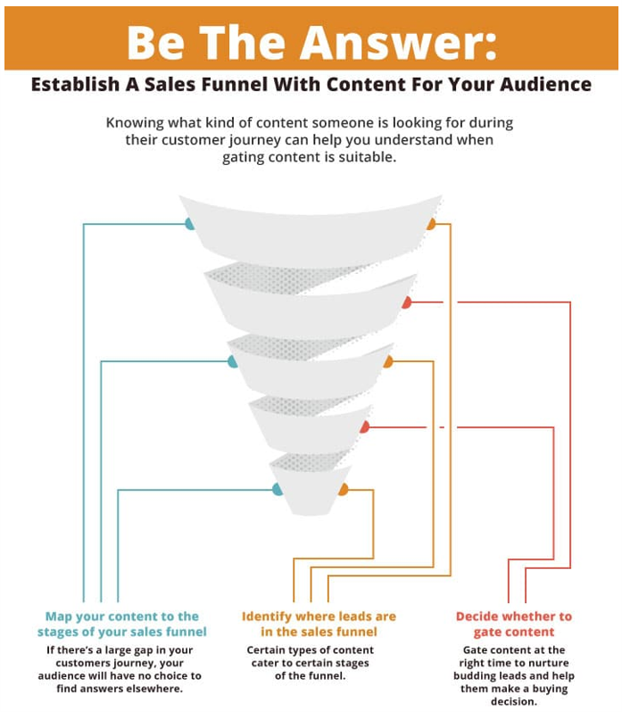
Knowing what kind of content someone is looking for during the customer journey can help you understand when gating content is suitable. Remember, with the Hub & Spoke Model, you’re using smaller sized content (spokes) to drive people down the funnel and eventually land on the gated content (hub).
With the customer’s journey in mind, follow these steps to determine if gated or non-gated content is appropriate:
- Map your content to the stages of your sales funnel: Your perfect content funnel may look different from others. You should have different content for each step in the buyer’s decision-making process. This starts with the broad thought leadership and helpful advice at the top of the funnel. The bottom of the funnel content helps customers evaluate your products or services before they make a buying decision.
- Identify where leads are in the sales funnel: A well-thought-out funnel model helps you understand this, too. Certain types of content cater to certain levels of the funnel. You understand where they are in the decision-making process based on the type of content they’re viewing.
- Decide whether to gate content: There comes a time in every funnel where the prospect intends to evaluate options for purchase. Think of gated content as a way to “make a move” on your audience. Gating content at the right time can help you nurture leads while supporting a trusting relationship with your brand.
What Did We Learn?
- Gated content is best for generating qualified leads.
- The Hub & Spoke model directly aligns with gated/non-gated content.
- Landing pages and Thank You Pages are critical for gated content to be successful.
- You must consider the customer’s journey when creating a strategy around gated content.
To gate or not to gate, that is the question. By mapping the customer’s journey and utilizing the Hub & Spoke Model, you can tap into your existing audience and capture leads that may turn into future revenue for your business. As always, be sure to measure the successes and failures of your gated content to improve your content marketing strategy for the future.