

Google Responsive Search Ads are Taking Over: What You Should Know
Digital marketers everywhere know the challenge of keeping up with ever-changing user behaviors. Luckily, today’s tools rely less on manual efforts and more on algorithms and machine learning.
Google is constantly developing new ways to answer users’ questions on their search engine. Last fall, in a decision representative of the industry’s shift toward automation, Google announced that it would be sunsetting expanded text ads (ETAs) on June 30, 2022.
Responsive search ads (RSAs) will take their place, allowing digital marketers to use increased automation to connect with their brands’ audiences.
But what’s the difference between ETAs and RSAs, and why use the term “sunset” to describe the change? Will marketers benefit from this decision? What can you do from now until June 30? Investis Digital is here to answer these questions.
Where will ETAs go on June 30?
If you’re worried about the data from the current ETAs you’re running disappearing at the end of June, don’t fear. Google has assured marketers that while you won’t be able to create or edit new ETAs after June 30, you can still stop, pause and resume the expanded text ads you’re already using. You won’t lose the data from these ads, and you’ll still be able to run them alongside responsive search ads.
How do RSAs work?
Responsive search ads offer several features you don’t get with expanded text ads. One of the most obvious benefits is in their name—these ads respond to users’ search behaviors by pulling in the most relevant headline and description from the options that marketers provide. (Responsive search ads should not be confused with dynamic search ads, which search engines create by pulling content from your website.)
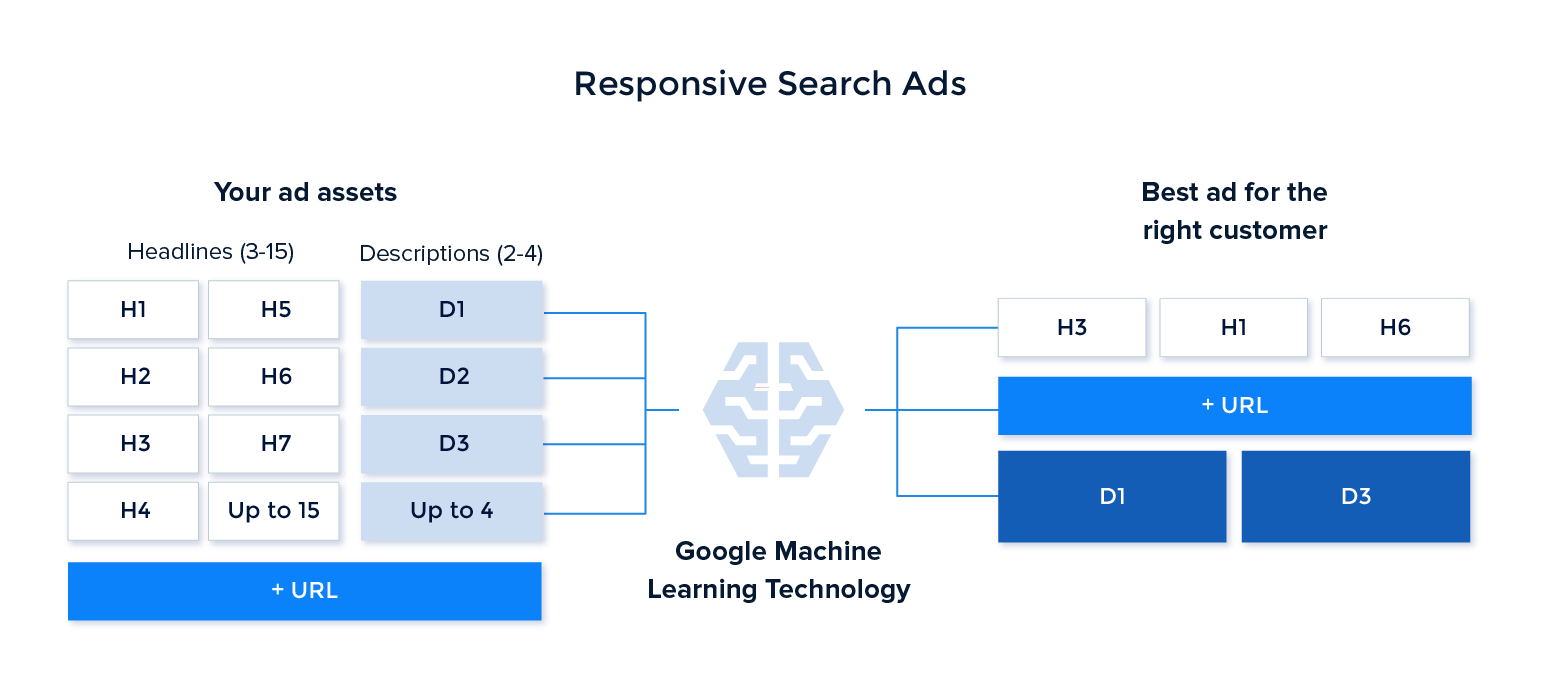
Image source: Instapage
Google’s algorithm takes the headlines and descriptions you provide and—based on what the search engine knows about the searcher’s intent and previous online behavior—puts them together in a way it believes will lead the user to the information or solution they're looking for. The number of possible ads Google can create depends on how many headlines and descriptions you provide. The more options you give Google, the more likely you’ll be able to successfully convert searchers with ad copy that speaks to their specific query.
Who benefits from this change?
For the most part, RSAs provide a better user experience than ETAs. RSAs are automated based on user data (provided voluntarily) from past searches and other online behaviors. The switch from ETAs to RSAs means that searchers will receive more personalized results for their queries.
This change can benefit marketers, too. RSAs provide a simple way for marketers to connect with their audiences without losing too much control and oversight. Along with more automation and personalization, RSAs offer:
- Device-specific optimization
- Easier testing
- Increased auction presence
- More time for strategy
Ideally, this switch will increase your chances of lowering costs and improving KPI metrics. The goal isn’t to take control away from human marketers, but to combine their creative thinking with machine learning to give users the most effective solutions to their queries. In fact, according to Google, advertisers that switch from ETAs to RSAs, using the same assets, “see an average of 20% more conversions at a similar cost per conversion.”
When we pulled our own data, we found that using RSAs alongside ETAs drove significant improvements for clients in several industries, including:
- Healthcare education: Over the last 15 months, a client in the healthcare education space has been running RSAs in tandem with ETAs. RSAs have captured significantly more impression volume on increased traffic, highlighting that the responsive format is prioritized when serving ads. CPC, CTR, CVR and CPA metrics were all weaker for the RSAs; however, their spend was nearly 50% stronger.
- Quick-service restaurants: Over the last 8 months, a quick-service restaurant client saw that even though ETAs drove impressions and conversion rates, RSAs closed the traffic gap and saw stronger CPA and CTR metrics.
- Higher education: A client in the higher education industry distributed spending relatively evenly between ETAs and RSAs over the course of 10 months. ETAs had greater impression volume, but traffic skewed in favor of RSAs, along with both front- and back-end efficiency metrics (CPC, CTR, CPA, CVR).
How you can prepare for the change
You don’t want to wait until June 30 to make the switch to RSAs, especially if ETAs are the only type of search ad you’re familiar with running, testing and analyzing. Even if you’re not ready to completely switch over to RSAs, there are still things you can, and should, do to prepare for the upcoming change.
Start experimenting with RSAs
First, you should include at least one responsive search ad with every ad group for your search campaigns. This will allow you to get familiar with RSA features that you don’t get with ETAs, such as ad customizers, ad strength recommendations, and more.
You should continue to test out RSAs, trying not to rely too heavily on generalizations based on results from single campaigns or results from other brands. You want to use what you know about your brand’s goals to inform your learning and improve your audience’s search experience. Even if Google says something will produce “better than ever” results (in so many words), real-life can be a little harder to predict and control, so don’t be afraid to adjust your ad groups as needed.
Investis Digital’s steps for success
To ensure that you’re able to benefit from transitioning to RSAs, you need to have the right tools and preparation in place. Before the change becomes official on June 30, you can:
- Test your best ETA content in RSA format. Google suggests making sure you have at least one RSA in your ad mix before June 30. The success of your ads may end up being different from the average results that other brands are seeing. The only way to really know what works for your brand is to test, test and test again.
- Strengthen your ads. With RSAs, you get feedback on the strength of your ads based on two components: the effectiveness of your ad, and the potential that they will convert users. Even though it’s not possible to see what specific ad combinations are performing well, you still have visibility into what needs refinement.
- Embrace variety. If you want to give your ads the best chance to convert users, you’ll want to provide Google with as much diversity in your headlines and descriptions as possible. The more variations they can pull from, the more quickly you will learn what works and what doesn’t for the people you’re trying to reach. Experiment with:
- Header lengths, especially when considering user experience on different devices.
- Description content, such as discount codes, special offers, key benefits of your brand, product or service features, etc.
- High-performing content from ads you’re already running, including ETAs.
Additional resources
- Google Ads Help: About expanded text ads
- Google Ads Help: About responsive search ads
- Google Ads Tutorials: About responsive search ads
- Think With Google: Write it right: 5 tips for creating impactful responsive search ads
Contact Investis Digital
We have experience helping clients in a variety of verticals refine and optimize their ad placement strategy. Learn more about our paid media & performance marketing solutions, or get in touch today.