

The 2022 Guide to Account Based Marketing
Today, everything and everyone is connected through technology. New technologies empower marketers to engage potential customers at every stage of their buying experiences. With dwindling attention spans and more clutter online, we face new challenges to influence potential buyers.
"The traditional model of linear deal progression, with a handoff from marketing to sales, won’t work for complex modern B2B buying." - Brent Adamson, Distinguished Vice President, Advisory, Gartner
Account based marketing (ABM) helps us meet these new challenges. If used effectively, Account Based Marketing can boost revenue and marketing’s return on investment.
What is Account Based Marketing?
Account Based Marketing includes the following:
- Identifying your best accounts by developing ideal client profiles (ICPs)
- Using data to gather detailed insights on your ICPs
- Using that data and analysis to align your processes to meet their needs
- Prioritizing your actions based on how you tier marketing opportunities
- Creating personalized content to meet them at the right time in the right channel
- Measuring, analyzing, and fine-tuning your efforts based on data
Account based marketing isn’t a new and revolutionary marketing strategy, but it has gained popularity in recent years. Account Based Marketing shifts your marketing focus from a volume-based lead strategy to a one-to-one communication style, modeled after sales strategies.
When I worked in the newspaper business years ago, we focused on what we called “key accounts.” These accounts were our best customers and we’d established great relationships with them. From these accounts, we identified look-alike organizations that aligned with our current best customer profiles. Today, digital marketing uses omni-channel strategies, cloud-based tools, and technologies for our Account Based Marketing programs.
How can account based marketing help your business grow revenue?
This post will cover what you need to know about Account Based Marketing, how to set it up strategically and how to implement the tactics, measurement and other processes that make Account Based Marketing campaigns successful.
Account Based Marketing aligns sales and marketing teams to collaborate on more personalized, targeted, and engaging content. When these teams work together, they can target specific organizations and craft customized marketing campaigns to move them through the sales pipeline before and after a sale.
This customer-centric approach focuses your strategy on a shared set of target accounts developed using an ideal customer profile (ICP). Once the list is established, and you’ve confirmed they’re a good fit for prospective sales, develop a personalized experience for key decision makers you’ve identified in each target organization.
Machine learning, artificial intelligence (AI), cloud-based marketing automation platforms, and other marketing strategies have made Account Based Marketing easier to implement. New marketing technology lets organizations focus their marketing and sales resources in an efficient, purposeful way. Account Based Marketing presents opportunities to expand business with current customers through cross-selling and up-selling, while developing relationships with ideal new prospects. It’s important to remember: Account Based Marketing is not a technology, it’s a marketing strategy.
Do I need Account Based Marketing?
Our job as digital marketers is to drive conversions and grow revenue. The new digital landscape makes B2B buying cycles more challenging and complex. Without the ability to meet in-person, marketers need to set up new communication channels.
Currently, 79 percent of marketing leads never convert into sales. What's more is that 82 percent of B2B website visitors are not potential customers to begin with. Without targeted Account Based Marketing strategies, you could easily be driving a high volume of leads that are either unqualified or do not resonate with the content you are supplying.
Does any of this sound familiar?
- My leads pipeline is faltering
- My inbound efforts are failing
- My sales cycles are becoming longer and more unpredictable
- My prospects have multiple decision makers/stakeholders and a multi-step process for making large purchase decisions
- My current digital marketing tactics aren’t delivering results
- My sales and marketing teams are siloed and don’t have common goals
- I need to reach implementers, influencers, and decision makers to sell my services
- My services are very niche
If you answered “yes” to more than three of these items in the above list, you may need Account Based marketing. Additionally, you should research the fundamentals of Account Based Marketing to determine if it’s a good fit for your organization.
What are the benefits of account-based marketing?
Account Based Marketing is a great approach if your organization sells to large, enterprise-level accounts that have multiple decision makers and longer sales cycles. Additionally, businesses that are ideal for Account Based Marketing usually need their clients to commit to large, long-term investments.
Investing time and resources in Account Based Marketing could yield these benefits:
- A more personalized marketing approach
- Increased alignment of sales and marketing teams
- Less time chasing down dead-end leads
- Increased demos and form fills
- Shorter and more efficient sales cycles
- Increased conversion rates
- Increased annual contract values
- Increased renewal rates
- More precise measurement of your marketing ROI
The biggest benefit to deploying Account Based Marketing is more revenue.
Account Based Marketing requires commitment
To get the benefits, you must be “all in” for Account Based Marketing. You can’t just give your current team Account Based Marketing work on top of their current workloads. The commitment is at all levels including creating new, personalized content. According to Eli Snyder, from Technology Strategy Director, Intelligent Demand, “You have to have content that’s highly personalized and engaging because it takes a lot of touchpoints to really get the engagement with the different members of the buying committee that you need in order to make Account Based Marketing effective. Your content needs to be personalized at the account level. It needs to be measurable at the account level. And most importantly, variety here is the key. You need a wide variety of content formats and channels.”
How to Create an Account Based Marketing Strategy
Some items that should be included in your Account Based Marketing strategy include:
- Create an overarching strategy
- Align your sales and marketing teams
- Determine your list of targeted accounts
- Identify key decision makers, influencers, and stakeholder within these accounts
- Decide what marketing initiatives you will use
- Determine when your sales team will get involved
- What KPI’s will you track for success
1. Create an overarching strategy for Account Based Marketing
With Account Based Marketing, always start with a strategy. Be sure to have an end goal in mind, and work back to determine the individual steps. Educate your Account Based Marketing team on your organization’s business goals for the coming year ahead, which are typically defined by your executive leadership and your board of directors. In most cases, there will be a strong focus on creating new revenue streams from new clients and from upselling and cross-selling incremental revenue from existing clients.
2. Get buy-in from across your organization
Successful Account Based Marketing requires that your organization go all-in. Beyond sales and marketing teams, you’ll need people from the C-suite, finance, customer service, and IT departments. This is a critical step in the process.
3. Align your sales and marketing teams
You’ll need to connect your sales and marketing teams for Account Based Marketing to be successful. In fact, they should have shared goals. With shared goals, you’ll be able to align your resources and efforts to one common outcome. HubSpot coined the word, ‘smarketing,’ which is sales and marketing combined.
4. Determine your list of targeted accounts
Identifying your best opportunities is crucial to sustaining a successful Account Based Marketing program. This requires the creation of an ICP or ideal customer profile. These are the organizations that your company wants to work with, grow, and retain.
The common attributes developed from your ICP will help align efforts internally. These accounts will be the best on your list, since they are your best customers. ICPs are accounts you’re currently engaging with, cross-selling, and upselling. Once you develop your profile, you can use it to find look-a-like organizations that you would like to work with.
To find ICPs, identify the common attributes of your current best customers, including:
- Business category
- Revenue
- Their current spend
- Services they engage with
- Other detailed criteria
Where can you find this information?
- Current database of information that should include, spend, profitability, services, length of relationship, results.
- Feedback from sales and marketing teams
- External data gained from third-party sources
Use this information to find look-a-like companies that mirror these criteria. You can better align your sales and marketing teams with an ICP. Once everyone agrees on the ICP, you can focus resources to maximize revenue.
5. Identify key decision makers, influencers, and stakeholders within these accounts
Because Account Based Marketing is more focused on identified targets, you’ll need to find who, within those organizations, can help you make the sale. Rather than trying to create awareness with everyone, you’re trying to get focused messages to decision makers within your targeted account list.
Ask yourself the following questions to identify decision makers, influencers and stakeholders:
- What are the job titles and responsibilities of the target decision makers?
- How long have they worked with the target account and within the industry?
- What do they care about?
- Are they the person that makes the decision or are they an influencer?
You can investigate your current client base to create a list of attributes which will help you identify similar people in other companies.
6. Decide what marketing initiatives you will use
Once you’ve identified who you’ll target, determine what marketing channels (both traditional and digital) you’ll use to engage with these current and potential clients.
Creating customized content that speaks to your organization’s value proposition is at the heart of Account Based Marketing. You should be creating unique content for each target account. Your content should put you in the position as a trusted advisor, not a salesperson. You’ll need to deliver tangible value that educates and aids in the decision-making process.
What Content Formats Should I Be Using with Account Based Marketing?
As you might expect, almost any content format will work. You’ll need to align the format with the personas (ICPs) that you’ve identified.
Answer these questions to help you decide what formats and where to publish your content:
- What content format do they prefer?
- Where do they go to consume that content?
- What is the cadence or frequency of their research?
- What KPIs will you track for success
- What are the minimum data points necessary to track your Account Based Marketing targets?
- Company classification (SMB, Enterprise, etc.)
- Business Category
- Size
- Annual revenue
- Current marketing spend
- Targeted spend
- Targeted services
- Open opportunities
- Closed opportunities
- What other data points are you tracking?
When you capture these data points, you can create a “score” of your top targets. This score will help you prioritize your opportunities and assign resources accordingly.
How to Implement Account Based Marketing
Once you’ve decided who will be on your Account Based Marketing team, you’ll need to decide what technology platform you will use to automate your Account Based Marketing process. You can’t be successful without automated processes.
What are the top Account Based Marketing technology platforms?
A solid Account Based Marketing program needs automation from inception through deployment and management. There are too many data points and steps in the Account Based Marketing process to do it all manually. You may have started an Account Based Marketing program manually only to discover that you needed automation to scale.
If you are currently using a CRM, you might already have most or all of the features and functionality you need to deploy your Account Based Marketing program.
There are many software platforms that you can use. Here is a list of the top 15 Account Based Marketing software programs:
- HubSpot: HubSpot's Account Based Marketing software is integrated within their CRM. Target specific organizations and tier them based on how closely they match your ICP. This software will help you align your sales and marketing teams.
- Terminus: This platform is a full-service Account Based Marketing software. Use it to build personalized account lists that align with your strategies to build your pipeline and revenue.
- Demandbase: This software was built with a B2B marketing focus and includes solutions for engagement and conversion. You can seamlessly share data insights and results.
- Engagio: This company is now a part of Demandbase and allow users to unify data from all their accounts into one platform.
- Triblio: This platform specializes in quickly scaling the growth of your targeted account pipelines. The software comes with a detailed guide on how to set up your Account Based Marketing program.
- 6Sense: User intent is the focus of this platform. Use their tools to learn about customer insights and hidden buyer behaviors so you can provide them with specific content based on their unique interests.
- LeanData: Use the platform to help align sales and marketing teams in their quest for more revenue through the use of data driven insights.
- Bound360: Personalize your Account Based Marketing strategy with this intuitive platform. Track how your segments are performing and make course corrections for best results.
- Zymplify: Use their tools to automate lead qualification along with reporting and other Account Based Marketing tactics to close sales faster. Find prospects that are actively looking for your services.
- MadisonLogic: Use this platform to identify the most valuable ICPs and move them through the customer journey faster by gaining insights into advertising campaigns.
- ActiveDemand: Built for agency use, this platform is a full-service suite of tools including lead nurture, content, reporting and landing page form creation. It allows marketers to streamline campaigns and attribution reporting.
- Vainu: This platform focuses on conversions and allows you to see who is interacting and engaging with your content. Their tagline is, “Data with the level of detail required for strategic sales and marketing.”
- Leadiro: This software uses demographic profiles to identify and connect with key decision makers. Target by specific geographic regions. Leadiro integrates with HubSpot. Empowers sales and marketing teams to identify active prospects, increase pipeline flow and drive revenue.
- AdDapative: This platform allows you to connect with high-value B2B leads and decision makers and to put your advertising messages in front of the right audience at the right time.
- RollWorks: This platform helps you automate sales outreach and through its machine learning and helps you turn ICPs into customers.
What should I measure with Account Based Marketing?
Account based marketing relies on data and analysis. The data you track and analyze will depend on your goals and ability to gather the data.
Here are some of the Account Based Marketing data points you may want to track:
- Social engagement from ICPs
- Total web visits from ICPs
- Unique web visits from ICPs
- Top web site pages visits
- Time on page
- Newsletter subscriptions
- Video views
- Percent of videos views
- Webinar registrants and participants
- Pricing table downloads
- Gated content views and downloads
- Number of meetings scheduled
- Number of meetings held
- Number of accounts closed
- Annual contract value closed
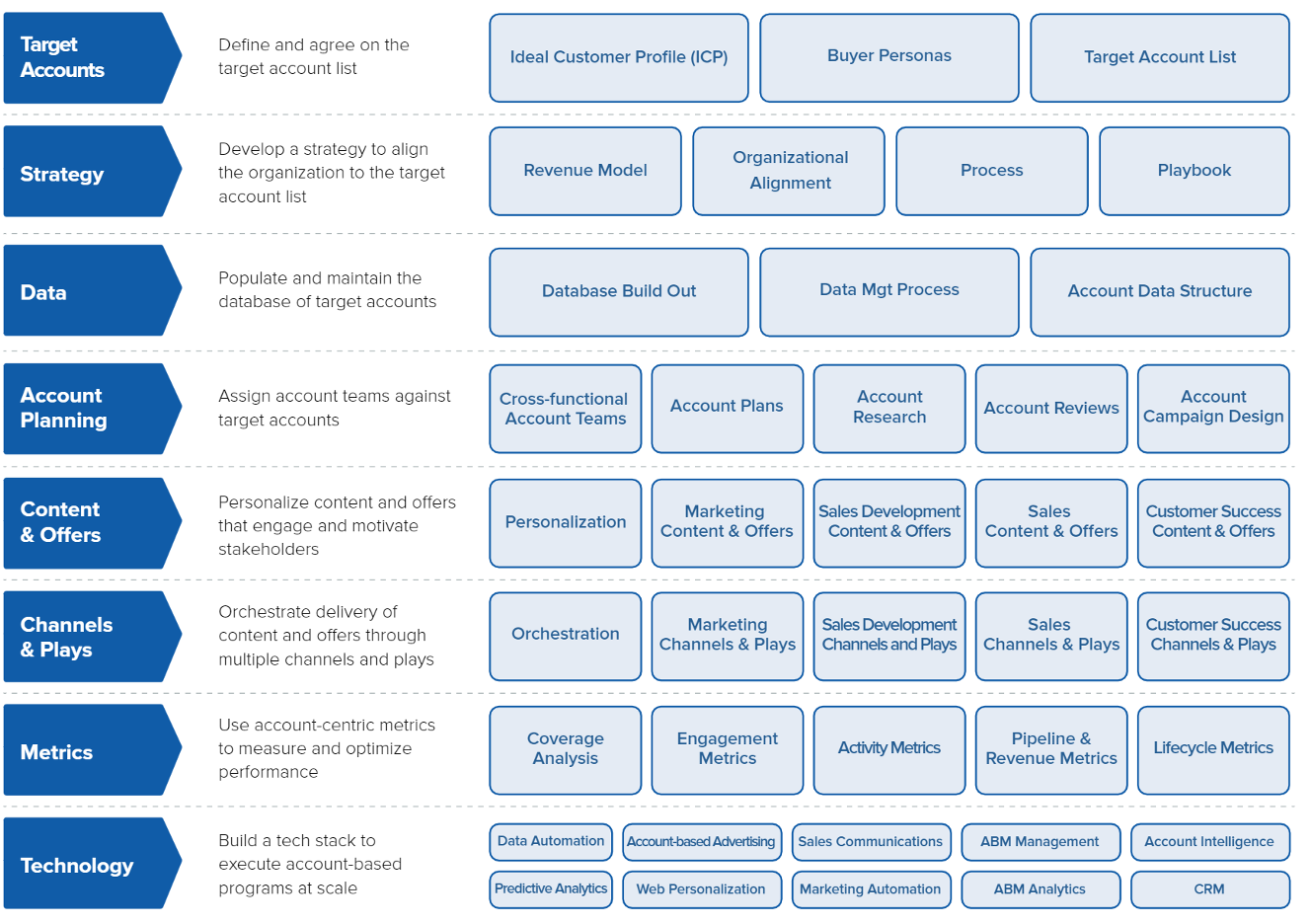
Account-based marketing could be just the thing your organization needs for success in 2022. If you’ve followed me this far, look at the table below from Gartner. The table shows what I walked you through with a strong visual representation of all the internal touchpoints of deploying an Account Based Management focused approach.
Contact IDX
IDX can help you reach and influence the audiences that matter most to your business with our ConnectedContent approach. Contact us, here.