

How to Create a B2B Sales Funnel
So just how do you create a B2B sales funnel? First, let’s get this out of the way: even though we are accustomed to calling the process of converting a customer from awareness to consideration to purchase, a “funnel,” it’s not and never has been a funnel. The sales funnel was invented in 1898 by advertising executive St. Elmo Lewis with the steps initially defined as attention, interest, desire, action. Quick question: are you using any other tech for business that’s 123 years old? Maybe a pencil at times, but that’s about it.
The sales funnel was always flawed. Funnels are constricted from the top and the bottom. Add too much and it spills over, and only so much can come out of the bottom no matter how much you add to the top. The funnel also assumes that everything you add in will eventually drop out of the bottom. That isn’t the case, especially in B2B sales or account-based marketing where companies could be targeting as few as 1,000 prospects.
Really, sales is more like a sieve. You know that screen thing miners use to sift through dirt and find gold? Put a shovel full of dirt in it, shake it around, grab the stuff you want to keep and let the detritus fall through. I know there’s no client action in this analogy. Clients don’t fall out of the bottom. They aren’t driven by gravity into your greedy little hands. But with this sieve analogy they do stand out, they are there for the taking to examine, polish, admire and cherish.

What do you need to build a robust 'Sales Sieve'?
- Salespeople who are true thought leaders and experts
- A robust inbound lead generation and nurture program
- Correct team structure to execute your strategy
That means a shift in the types of team members you have on your sales team, your attitude about the sales function, as well as embracing the new paradigm of B2B sales once and for all
The New Sales Team
So, what does B2B sales mean? Here’s my definition: establishing expertise for a problem a business prospect needs to solve, identifying the correct contacts at those businesses, providing useful information to them so they ask for your help, and then delivering that solution at a competitive price when the business prospect is ready to buy.
Most marketers we talk to call this “account-based marketing,” which encompasses all of the items above, except closing the sale. Wait just a minute! Aren’t we talking about sales? Yes, we are. B2B sales means spending most of your efforts marketing your expertise with the salespeople and specialized marketers leading the charge. That means providing valuable content and then proving your company will provide a solution better than your competitors.
B2B sales does not mean having a bank of cold callers or BDRs firing in the dark hoping someone will answer a phone or respond to an unsolicited email. Yet so many companies still operate under this sales model.
Businesses grind away in an antiquated system of cold calling to fill the antiquated sales funnel only to wonder why they don’t have many prospects. Definition of insanity, anyone? In addition, most B2B companies have limited prospect pools. Bug those prospects too much with useless messaging such as “just checking in,” and those prospects will block you.
COVID-19 turbocharged the drastic shift in buying habits for consumers and businesses. In person meetings? Out the door. Spending an hour just to get to know a product or company? Gone. The current estimates are 50-90% of the business buying process is done before talking to a salesperson. So why do you have a team of cold-calling salespeople versed in Spin Selling? The old sales team used to consist of that room full of salespeople, with an assistant to fire off proposals and book sales trips. For argument’s sake, ¾ selling, ¼ support. It was a volume game. Now, you must have ¾ content creating experts and ¼ selling. As you will see below in “What skills should a B2B seller have?” those skills can be wrapped up in a new unicorn salesperson.
Consider the new sales team to look something like this:
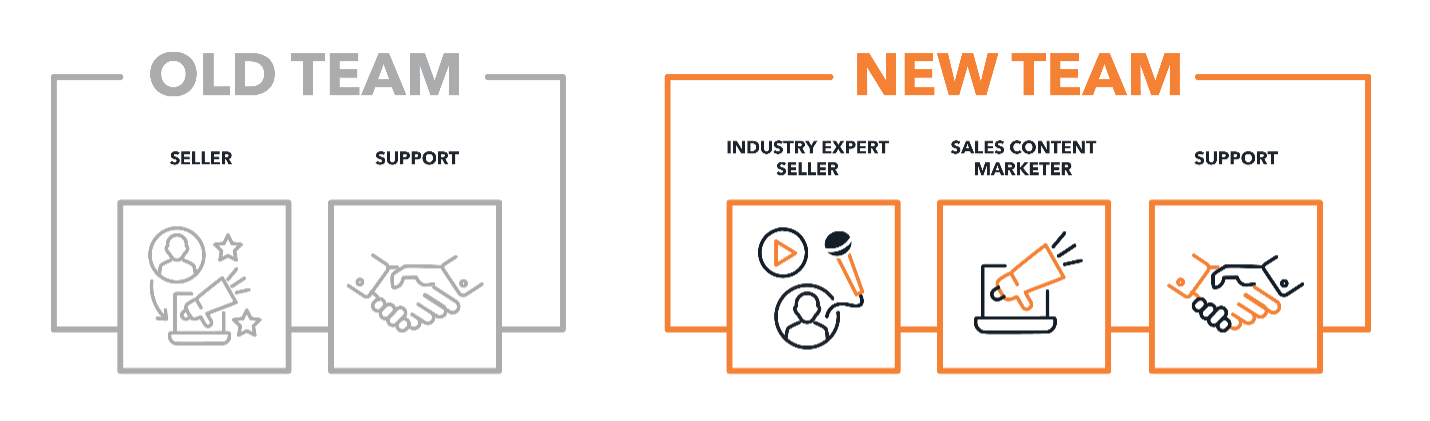
The New Unicorn Salesperson
Exceptional salespeople have always been unicorns. A common belief is that 20% of salespeople produce 80% of sales and , we all know, the good ones have always been hard to find. That hasn’t changed, but the skillsets you should be seeking in salespeople have.
What skills should a B2B seller have today?
- Content creation expertise, including Power Point, Blogs and Videos
- Outstanding presentation skills, especially on video
- Creativity
- True, hands-on expertise in the field in which they sell
- Ability to simplify and convey complex strategies
- Negotiating prowess
- Competitiveness and closing prowess
The new sales unicorn has shifted from a “take no prisoners” attitude to a creative communicator who can then shift to strategist and then to negotiator. Look for someone with a creative undergrad such as writing, performing arts, or video production.
Another must for new salespeople is being comfortable on camera and on stage. Establishing true expertise and value requires video and speaking appearances at conferences. The goal is to have your limited prospects excited to hear from a salesperson because of the knowledge they share.
Here’s a sample job description for the new B2B salesperson:
X company seeks a creative, driven, self-starter to who has expertise, or would like to be an expert in (industry). The ideal candidate will have a degree in fine arts, writing, music, video production or other creative degrees. In addition, the candidate must possess analytical, strategy and negotiating skills. Public speaking and on camera presence is also a must.
What about that must-have “Sales Content Marketer?” This person should be adept at creating content your niche audience finds indispensable. That means the Sales Content Marketer should be able to:
- Shoot and edit outstanding videos
- Interview experts and produce written blog content
- Facilitate nurture programs
- Build sales pitch microsites
Some of you might think you have this covered with your marketing team. You probably don’t. The reason being, focus and total integration with the sales team and leadership. Remember, you are gently shaking a small group of valuable prospects. You must be consistent, patient, and meticulous. In B2B sales, you can think of this sales marketing person as a replacement for a BDR, appointment setter or cold caller.
Creating an Inbound Machine
Now that you have your team in place, it’s time to build an inbound lead machineby delivering consistent, undeniable expertise so your niche B2B buyers know who to turn to when they need your solution. When they do turn to you, your expert salespeople and sales content marketer should lead the charge. The key ingredients of this inbound lead machine are a plan with goals, consistent content, thought leadership and patience.
Plan with Goals:
A plan with goals seems like a no-brainer, but so many don’t take this critical step and still expect results while winging it. Don’t fall into this trap. Take the time to build a detailed plan starting with a measurable KPI.
I prefer the simplest metric, how many “solution presentations” we make each month. A solution presentation means showing the prospect how we will fix their problem, with expected results and the charge to do so. It’s a small number at the tail end of marketing and inbound efforts.
Many organizations get caught up in MQLs (marketing qualified leads) and SQLs (sales qualified leads), but those are vanity metrics when you are a B2B business with a limited prospect pool. It’s the same reason why the concept of a sales funnel doesn’t work, either. When you shake that sifter, the quality of the prospects matters more than quantity.
Sticking with a plan makes sure you stay on task, and provides consistent, valuable communication to your prospects. You should structure your plan by type of outreach, when you will deliver it, and who will own the effort. For example, you may want to send out a monthly e-newsletter, build interactive webinars, create blog posts, push content, bothorganic and paid, on LinkedIn and promote your upcoming speaking appearances. Each should have an owner on your team to build and facilitate the schedule to make sure their segment happens.
Try a monthly spread sheet with each task broken out along with due dates and the owner of the task. Each quarter, take time to evaluate the results, what worked and what didn’t, then build the monthly schedule for the next quarter and so on.
Once your schedule is built, hold your team members, and yourself accountable. Review your plan at least once a week. Implement a “no excuses” policy. No matter how busy a team member is, they will get their prospect nurture tasks done. If someone is particularly busy with pitches, be a team, come together and cover for them, but don’t let your plan slide because consistency is key.
Consistent Content:
That consistent, expert content should come in the form that most resonates with your audience. If it’s a chat forum, make sure you are an active participant in providing solutions and answers, not selling your product. Make sure you also own the conversation by creating searchable content that answers questions – like this blog post!
Video plays a key role in this. Make snappy videos that show your personality and expertise. Be sure to build and promote a YouTube channel. YouTube is the second largest search engine after Google. Why wouldn’t you use it?
Create bio pages that show off the experience of your salespeople, as well as their personalities. Showing your team is made up of“real people” helps prevent spreadsheet buying and mitigates the disadvantages of no longer meeting in-person. Your salespeople should also be sending brief video messages throughout the pitch process either with a “selfie” iPhone video or something like Vidyard.
Your Sales Content Marketer will be the ringmaster for outbound content. They should work together with the marketing team to make sure paid social supports salesperson content, and that the outbound effort is aligned with larger, global marketing pushes. Doing so ensures efficiency across the company and that sales do not operate in a silo.
Thought Leadership:
Salespeople speaking at conferences is powerful. It creates and reinforces expertise and credibility. It also makes prospects feel more comfortable and familiar with the salesperson and the company. There’s a ton of competition to speak at events and you may want to consider paying to speak to build your cred.
When you do speak at conferences make sure you’re not selling. Again, make sure you’re not selling, especially if it’s a paid sponsorship to speak. Your job is to prove you know your stuff better than any other team out there. Yes, salespeople should be on the stage, but you must establish them as vital resources worth listening and turning to first.
Your thought leadership effort should tie in with your consistent content and your overall plan. Each should build upon one another. Keep it up long enough and earned media will come your way. Which leads me to the final ingredient of your Inbound Machine: patience.
Patience:
If you are expecting instant gratification, B2B sales and marketing is not for you. Publish, publish, publish. Stay consistent and let it grow. Don’t be discouraged if there aren’t many email opens or clicks. Many email programs block tracking anyways and privacy will only become more robust in the future.
The same goes for expecting leads to land in your lap after a speaking engagement. Just because you blew a prospect’s mind with your conference appearance doesn’t mean they are ready to buy. Add those prospects into your nurturing content program, give them a gentile shake of useful information, then grab those little nuggets when they are ready to go.
Takeaway
Take a critical look at the structure of your sales team, and the type of sellers and marketers you hire. If you suspect that your company does things because “that’s always been the way” then it’s time for change. B2B and account-based sales leads are limited, so you must nurture them and provide value. If, and when you get pushback from your colleagues that are stuck in their old ways, ask how them how they decide to buy a certain product or service. You will hear their story of discovery, increased brand awareness, and their ultimate decision to buy without pressure or cold calling.
Contact Investis Digital
Investis Digital can help. Our Connected Content approach is designed to help businesses amplify their content across the digital world. Contact us to learn more.