

What is the Impact of Advertising on Streaming?
The entertainment streaming industry has grown rapidly in a short period of time. For years, Netflix dominated the industry. But recently, streaming services such as Amazon Prime Video, Apple TV+, Disney+, HBO Max, Hulu, and Peacock have emerged to challenge Netflix. Those services have created a content creation war. And it costs a lot of money to create content ranging from Severance to The Mandalorian. Streaming companies are on pace to spend $230 billion on content in 2022.
No wonder more streaming businesses are embracing advertising to defray costs. Advertising brings in revenue. An ad-supported tier, coming at a lower cost than an ad-free tier, creates more subscribers. The two latest platforms to make a move into ad-supported platforms are Disney+ and Netflix.
Netflix, which long resisted accepting ads, cried uncle in April when the company announced a rare loss of subscribers for its most recent quarter. Disney, on the other hand, is moving full steam ahead with advertising in 2022 even though its subscriber growth is actually exceeding Wall Street analysts’ expectations.
All this matters because streaming companies are the content creators behind the uptake of over-the-top (OTT) television, or TV viewed over the internet. (This is also known as connected TV.) With OTT viewing experiencing explosive growth, it’s worth understanding streaming ad models because they will set the standard for how people experience entertainment content online.
Taking a Closer Look at Advertising on Streaming
Ads on streaming platforms are not new. Hulu and HBO Max have been incorporating ad-supported tiers for some time. Hulu’s model is probably going to influence whatever Disney+ and Netflix do.
Hulu’s approach is to offer a less expensive tier that includes ads. But the ad experience is not like the predictable 15- and 30-second spots that characterize linear TV (although those do exist). No, Hulu’s approach is to offer multiple options befitting the different ways people experience content on Hulu.
For example, Binge ads let advertisers deliver contextually relevant messages to the audience during a viewer’s binge session. These ads help businesses to engage with audiences in a non-disruptive way. Binge ads are for viewers who have watched three or more shows of the same series. And who hasn’t binge-watched their favorite show?
On the other hand, Sponsored Collection brand placements gives advertisers extended ownership of a collection sponsorship through logo placement adjacent to content in Hulu’s user interfaces across devices. Hulu’s Pause Ad is a non-disruptive, non-intrusive user-initiated ad experience that appears when a viewer presses pause when watching content.
And these are but a few of Hulu’s ad units. Here are more. Take a close look at them. Disney+ and Netflix certain are. Hulu and Disney+ are both part of the Disney family of brands. And Netflix CEO Reed Hastings has publicly cited Hulu as a model for advertising. He said Hulu is proof that ads work: Hulu ended 2021 with 40.9 million paying subscribers, up from 35.4 million a year ago. That’s a lot better than Netflix, which lost subscribers without advertising.
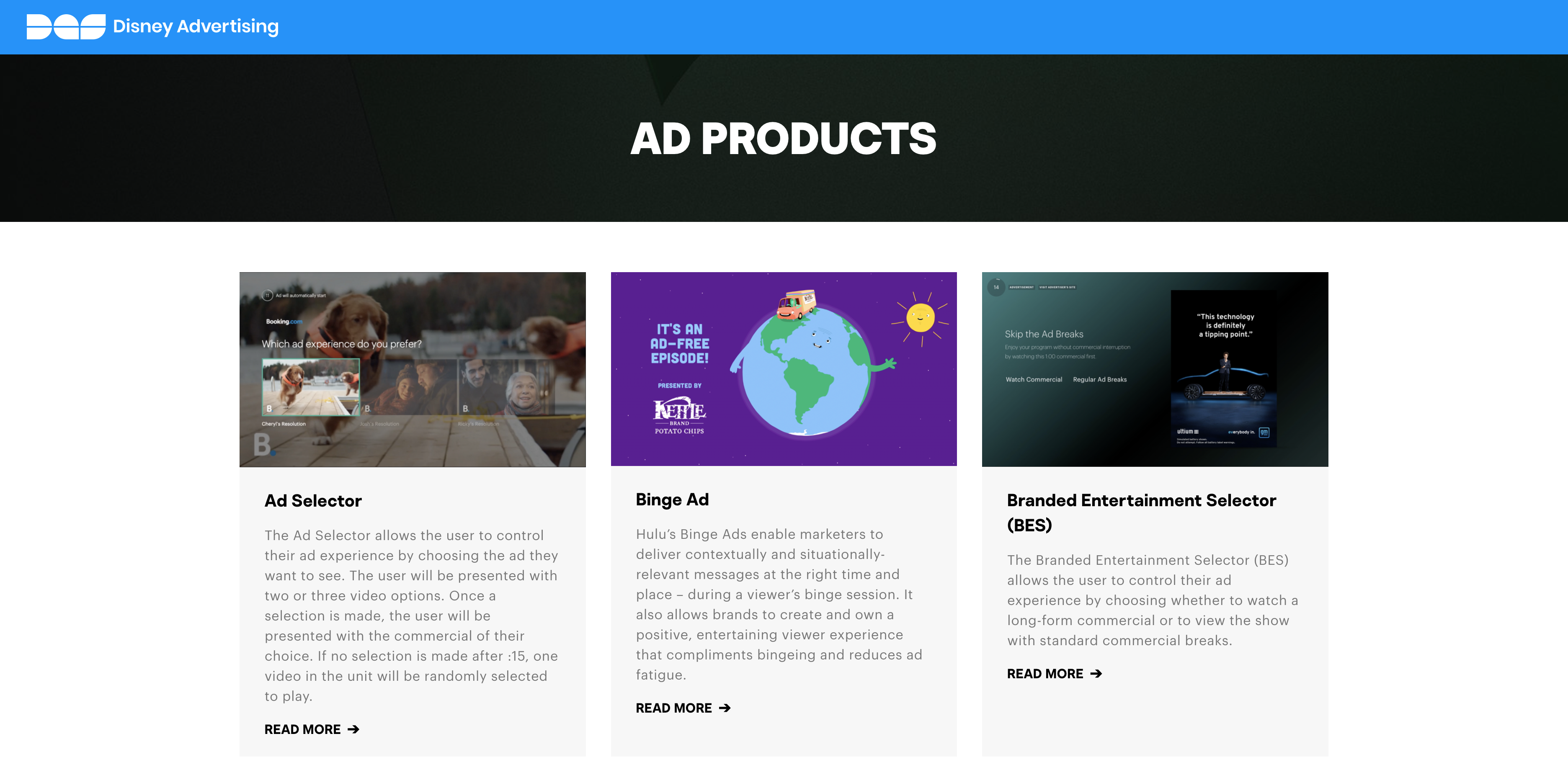
But for all the attention that big streaming companies receive, some of the more interesting advertising experiences come from an often overlooked veteran of the streaming world: YouTube. And YouTube really created the template for different ad formats that Hulu has expanded upon. Anyone who watches the free version of YouTube knows that ads can appear as bumpers on either side of video content or as more interruptive spots. But YouTube also offers more organic look ad formats, such as Masthead, where a brand can showcase your its, product, or service in a native video-based ad format that appears in the YouTube Home feed across all devices.
But perhaps the most interesting OTT-era ad format of them all slipped in largely undetected in recent weeks: virtual product placements (VPP). These consist of placements of products in actual content that look organic, but really aren’t: say, in a scene when someone is walking past a storefront, when they walk by a display or Starbucks coffee products or Coca-Cola brands.
Amazon Prime Video and Peacock both released their own VPP tools.
Amazon Primes’ VPP tool, operating in beta, lets advertisers place their branded products directly into streaming content after they have already been filmed and produced. Peacock’s new “In-Scene” ads will identify key moments within a show and digitally insert a brand’s customized messaging or product post-production so that the brand is showcased in the right TV show/movie and at the right time.
VPP is especially fascinating because it brings a more organic form of paid content to streaming, like product placements in movies and shows on linear TV. Everything old is new again.
Lessons Learned
Brands outside streaming can learn a lot from how advertising is making its way into OTT:
- Choice matters. Let audiences decide what they want. For streaming, that means providing different subscription tiers. For content providers of all kinds, that means a lot of things such as respecting privacy with proper opt-in measures; giving your audience choices of long-from and short-form content; and meeting them where they are on the device that matters most to them.
- Flexibility drives content, both paid and organic. Business-to-business and business-to-consumer companies have more paid and organic content options than before, ranging from Snapchat lenses to LinkedIn Carousel Ads. The days of interruptive ads are not quite over – but they no longer dominate.
Contact IDX
IDX helps businesses figure out the balance between paid and organic content through our Connected Content approach. To learn how we can help you, contact us. Learn more about our work here.