

SEO or Paid Search? Wrong Question
Our clients often ask us, “Should I invest in search engine optimization or paid search?” However, this question fails to consider key elements like competition, targeting capabilities, and client resources. That’s why we recommend leveraging both paid and organic search whenever possible to maximize your share of the search engine landscape. So instead of pitting these tactics against one another, we’re going to answer more relevant questions like:
- How have search engine results pages (SERPs) changed over time?
- Why should I use SEO and paid search together?
- What can I do to maximize my results with both SEO and paid search?
A history of SERPs
First, let’s explore how Google’s search engine result pages have changed over time. When Google first started in 1997, there were 10 listings on each page, and all were organic. In 2000, Google introduced Adwords, giving advertisers their first chance to bid on search engine real estate. Since then, SERPs have grown even more to include maps, knowledge graphs, featured snippets, products, news, images, and more. The combination of ad placements and new SERP features have resulted in less room for traditional organic search engine results on page one of Google.
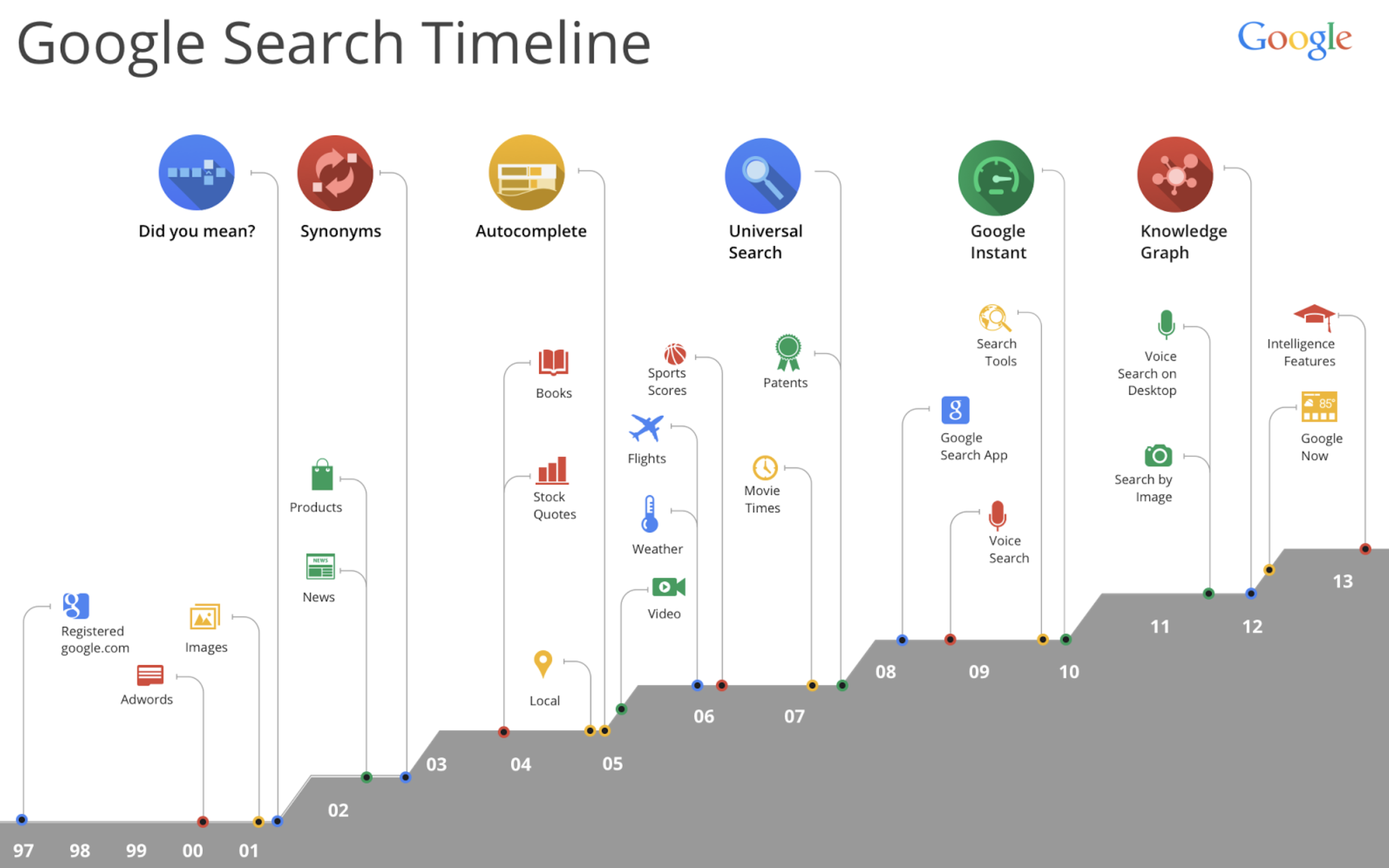
Figure 1: Google Search Timeline (Source)
Let’s take a trip back in time. The below screenshot is an example SERP for “casinos” in 2001 (Source: Search Engine Land). While there are five visible ads, organic listings still take up most the space above the fold on desktop.
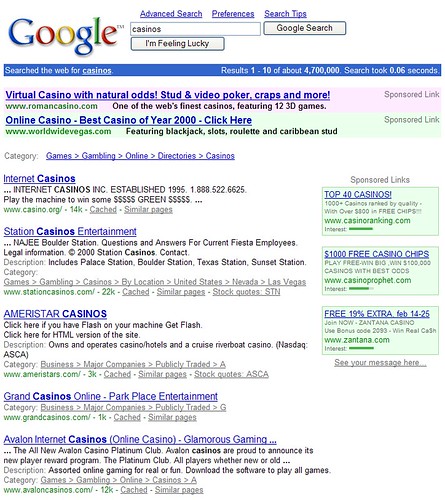
Figure 2: Google SERP for "Casinos" in 2001
Now let’s fast forward to a Google SERP for “casinos” in 2022. On a desktop, you can see that an ad placement and a map pack are taking up all the visibility from above the fold. Additionally, you’ll also notice that ads have evolved to look more like organic results than they did in 2001, so it’s harder for an untrained eye to tell them apart.

Figure 3: Google SERP for "casinos" in 2022
Zooming out and looking at the entirety of page one, you can see that the length of the page has increased to accommodate new SERP features and ad placements. In total, this search resulted in the following on page one of Google:
- 6 organic search results
- 4 ad placements
- 1 map pack
- 1 section for people also ask
- 1 section for top stories
- 1 section for videos
- 1 section for images
In other words, ads and new SERP features have become more prominent, while traditional organic results have become less prominent over time.

Figure 4: 2022 Google SERP of "casinos"
If organic search results are losing prominence, why invest in SEO?
Traditional organic results are less common than they were 20 years ago, but it doesn’t mean that SEO has lost its punch. First, let’s consider the fact that traditional organic results are still the most common element on the page. Second, remember that newer SERP features like map packs, people ask boxes, knowledge graphs, and featured snippets are heavily influenced by search engine optimization. That said, here are three more reasons why SEO is still worth considering in 2022.
1. You can see a high return with relatively low investment
Despite diminishing organic prominence and increasing competition, SEO is still a cost-efficient tactic for increasing traffic to your website. SEO requires resources to create content and develop a website, but this investment lasts for a longer time than advertising with paid search. This is especially true during economic downfalls like the one that accompanied the COVID-19 pandemic. In 2020, many of our clients had to decrease or eliminate their marketing budgets, which prevented them from running paid media campaigns. Nevertheless, clients who invested in organic search saw their performance sustain or continue throughout the pandemic.
2. Organic search’s longevity
If organic and paid search’s return were to be plotted on a graph, you would see two different trend lines. Organic typically returns an exponential trendline, starting off minimal and slowly continuing to grow up and to the right. This is especially true if brand awareness tactics are being run concurrently. It’s often that over time you will see available organic impressions rise as upper-funnel investment increases.
As for paid search, you may see a linear growth path. Pending proper ad strategy, an immediate return may be achievable, whereas organic search may take at least 90 days to show trends related to optimizations. Because of this, organic search is seen as a slow and steady performer. Paid search often steals the show from organic search because of its ability to generate lead or conversion volume nearly immediately. However, as soon as you stop spending, so does the return.
Imagine the power of both.
3. Organic drives visibility for long-tail keyword variants
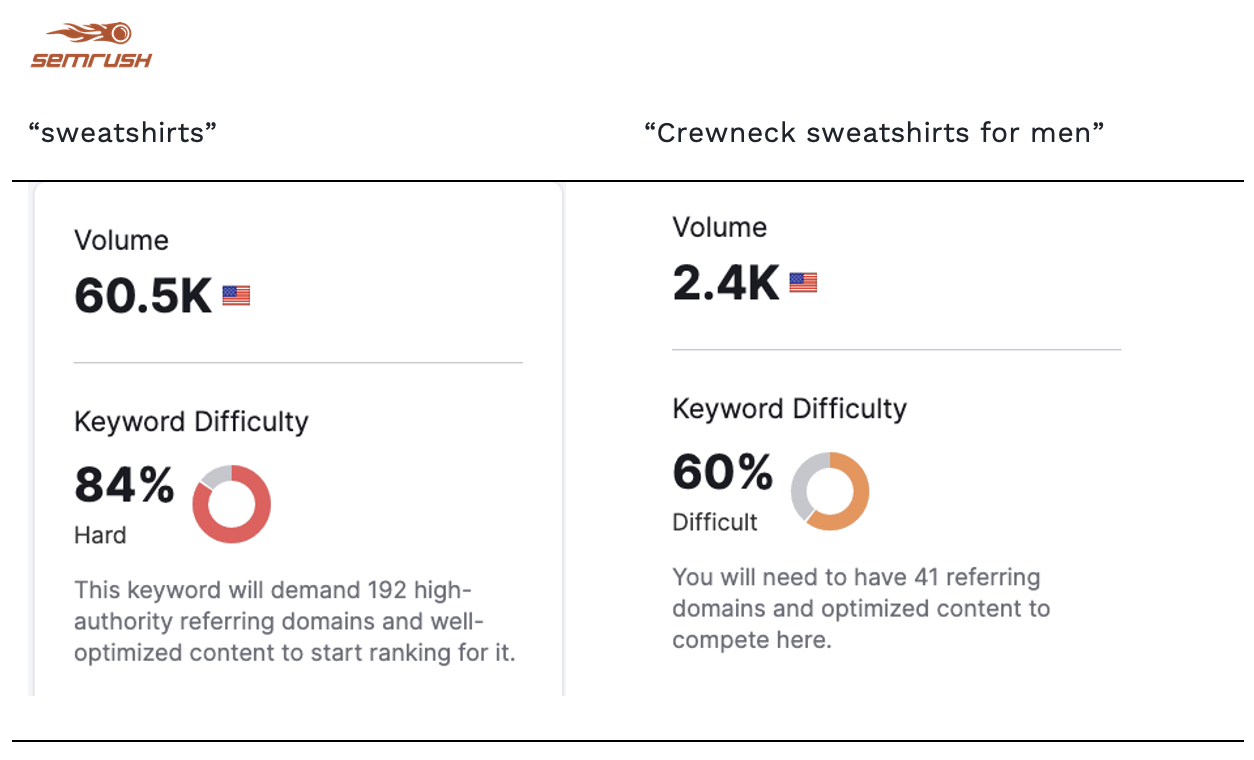
While broad match and phrase match are available keyword modifiers to increase a marketer’s likelihood to show their search ads for relevant search queries, organic search can capture long-tail variants that paid would otherwise not. We often see that longer-tail SERPs are also less competitive, allowing organic search to be in a prominent position in an equally qualified SERP as a highly searched short-tail variant.
For example:
4. SEO tactics directly impact Paid Search’s performance
At its simplest, SEO typically informs on-site content based on many factors, but most common is search interest and intent. Within the ad auction, quality scores are critical for success. The content on the designated landing page is a factor of the ad quality score. If the content on-site is irrelevant or misleading to the keywords we are bidding on, quality scores will be hindered. In the same manner, if you choose to serve Dynamic Search Ads (giving freedom for AI to determine ad copy based on the on-page content available), there must be sufficient and relevant copy for the machine to gather content from.
Additional Google resources:
The same is true on the back end of the site. Typically, structured data markup is seen as a technical SEO tactic, and the conversation ends there. Yet schema can also improve ad performance.
What is structured data markup? Structured data is a snippet of code within the header of the HTML that helps search engines understand what a page is about. You can think of it as the common language of search engines. That said, if you have errors in your structured data, this can potentially hinder the ability to serve ads since search engines read it as they would content on your pages.
For example, Google Shopping ads reference structured data to ensure the proper price is displayed in the ad. If the structured data and the user facing price on the landing page do not match, the ad will not serve.
Additional Google resources:
- About Structured Data Markup for Merchant Center
- About Automatic Item Updates
- Provide High Quality Data
Additionally, rich snippets are available on both organic and paid search listings where structured data is referenced for eligibility. Rich snippets allow your SERP listing to stand out among the rest such as incorporating additional sitelinks, product details, or review stars.
For example:

Lastly, page load efficiency can directly impact the users’ ability to experience a website, submit a form, or convert on an ad. SEOs closely monitor Core Web Vital metrics which have been recently deemed as direct organic ranking factors for user experience in the Page Experience update in June of 2021. While Google doesn’t reference Core Web Vitals in their Ad Position and Ad Rank documentation, they do state the quality of the landing page as one of the six ad rank factors. In their support article, 5 Tips to Use Quality Score to Improve Ad Performance, they also list the following optimizations to improve landing page status in your quality score:
- Make your website mobile-friendly
- Improve load speed. The speed at which your page loads can be the difference between a bounce or a purchase.
If you can’t tell, these are the same changes an SEO would recommend a developer make to improve Core Web Vital metrics.
So, when should we decide to bid?
The most common question as it pertains to organic and paid synergy is, “Should I be bidding on my branded terms?” As any marketer would respond, it depends. But the rule of thumb is if you are able to drive incremental clicks, then absolutely!
If your brand operates in a niche industry with minimal competition and prominent organic listings for your target brand queries, it may not make sense to bid and allow for your organic positions to pick up the traffic instead – after all, you worked hard to establish this!
However, if any of the below ring true, there is a case for you to use paid search on branded terms to protect your brand’s position in the SERPs:
- Competitors, partners, or retailers are bidding on your branded terms
- The SERPs are extremely convoluted and incorporate Google-owned SERP features that push organic listings below the fold
- Your brand offers promotions that you want to ensure are prevalent to the end user
The same is true for non-branded traffic. While your organic position may be strong, you may be leaving valuable leads on the table by not being in the auction to secure the most prominent position available in the SERP.
Takeaways
There are three key points we need to keep in mind as marketers through the evolution of Search:
- Google and Microsoft are here to make money. Available ad placements and ad types will only increase.
- Machine learning isn’t going away – adopt it or fail. Expanded Text Ads are already on their way out the door, forcing marketers to use Responsive Search Ads. Marketers that think in a static environment will get left behind. This is true for organic search as well. Algorithms are only getting smarter. As they mature, the more “context” they understand. We saw this with the rollout of Google’s BERT update in October 2020. While keyword stuffing is already a dated SEO tactic, updates like these put more emphasis on technical and usability optimizations instead of focusing on the inclusion of various keywords that are semantically similar. What is best for the user will win.
- The cost of ad auctions will only increase and the fight for organic search clicks will become more difficult as CMOs make digital a priority for increasing bottom-line performance. Not to mention the demise of the third-party cookie in 2023 that is likely to decrease the amount of available data ad platforms can collect, therefore inflating cost per results.
How can Investis Digital help you?
We partner our SEOs and search analysts to ensure that product feeds, structured data markup, and landing pages are properly optimized to give your brand the best chance of standing out in the SERPs. With data aggregation between Google Ads, Analytics, and Search Console, we are able to monitor total search performance to ensure the entire landscape is being accounted for.
Instead of asking “Which tactic should I use?,” ask “How can I use both tactics together to maximize my presence in Google?”
Need more help? Click here to learn more about our Performance Marketing Solutions or get in touch with our experts. We'll point you in the right direction.