

Aligning Your Link-Building Strategy with Current Events
Link-building campaigns can be uniquely affected by global events, since the ability to earn links is directly dependent on receiving replies from webmasters — actual human beings who likely have more important things on their plate than responding to web requests. And it’s difficult to find a global event with more far-reaching impact than the COVID-19 pandemic.
In order to continue to grow your backlink profile during uncertain times, you may have to adapt your strategies to better align with current events, the pandemic being a major one. It all comes down to making use of your most relevant content, adjusting your outreach emails, and exercising an increased level of patience. This blog post takes a closer look, including examples from our own client work.
Identifying Relevant Linkable Content
Our team adamantly believes the key to content-based link building lies in creating content that is in-depth, helpful, and as unbranded as possible. During a crisis, there are some additional considerations you should keep in mind when deciding what types of content you should use in your link-building campaigns.
As COVID-19 continues to dominate the public consciousness, ask yourself if the most “linkable” pages on your company’s website have changed. In some cases, it may be wise to pause link-building efforts for that new piece of content you published right before the outbreak in favor of something that will spark more interest. Data from Google reveals that now more than ever, consumers are searching for resources that can help them adapt to the changes in their life.
One of the first things our link development team did when COVID-19 began to hit the United States was to create a list of content on client websites that we felt was relevant to the pandemic. We knew that our chances of earning natural backlinks would be higher if we refocused our efforts on these pieces.
Before you spend hours searching for potential linking opportunities for a piece of content, ask yourself these questions:
- Is the piece up to date? With the news changing so fast, it’s important to make sure that the information in your article is accurate and up to date before you start pitching the content to webmasters. If you are trying to build links to an older piece of content, check it over to make sure it is still relevant, and consider removing the publication date from the byline if the information is evergreen.
- Does the content address relevant problems for today’s society? No matter how well-written your content is, there are some topics that are frankly not relevant when everyone is confined to their homes. For example, a blog post on a college website discussing how to navigate living on-campus for the first time may not perform so well right now.But a blog post providing tips for how college students can combat stress and anxiety (even if the post doesn’t specifically mention COVID-19) has plenty of potential to continue to earn links.
- Will this topic grab the attention of webmasters? The COVID-19 pandemic has shifted priorities for all of us, including those who manage and update web pages. Be mindful of that and realize that it may be best to put certain topics on the backburner until some sense of normalcy returns. Imagine, for example, that you are trying to earn a link for an older piece of content on a resource page located on health and wellness website. During the height of the pandemic, the admins of the site will probably be focused on providing their visitors with information related to COVID-19. They may not have time to consider your resource suggestion if it falls outside of this umbrella.
With this in mind, is it worthwhile to create new content that specifically mentions and responds to the crisis at hand, or can your link-building campaign survive on pitching older—but still relevant—content? It depends on your industry, the type of content already living on your site, and the resources that are available to you during this time.
One advantage to creating new content is that it will almost certainly be more effective at earning links on websites and resource pages meant to provide support to people affected by the crisis. Content that responds to breaking news can also help you stay engaged with your audience while providing useful and relevant information.
On the other hand, if you have older content on your website that remains relevant during the crisis, you may be able to see success leveraging these pieces. In the weeks since the COVID-19 pandemic began, our team has become adept at taking older pieces of content and pitching them in a manner that explains their value for today’s audience.
Adjusting Outreach Emails
If you’re anything like us, you probably make tweaks to your email templates depending on things like the day of the week, the time of year, if there are any upcoming holidays, etc. So, with a news story as all-encompassing as the COVID-19 pandemic, it makes sense that you should update your email templates to reflect changing times.
Some of the changes you can make are small and simple, where others require a bit more time and thought.
We encourage you to consider updating the following elements of your link-building emails:
- Greeting. Adding in a short line at the beginning of your message that acknowledges the strange time we are living in can help make your email feel more authentic. It can be something as simple as “I hope your week is going as well as possible during these uncertain times” or “I hope you are staying safe and healthy.”
- Value Proposition. In the section of your email that describes the resource you are offering, make sure to be specific about why you think your resource could be useful and timely for the site’s visitors, tying it back to current events. Think back to why you choose to leverage this piece of content in the first place and try to summarize your reasoning in a sentence or two. The value proposition part of your email is going to change on a case-to-case basis depending on the type of site you are reaching out to. So, even if you are using a template, be sure to add in details that explain why your resource is relevant for the specific website’s audience.
- Request. It's important to avoid sounding spammy or desperate in your outreach emails — especially if you are pitching resources on sensitive topics related to the crisis. If you are providing webmasters with resources that provide actual value to their community, they are likely to include a link back to it without too much pushing. So, while it can sometimes be helpful to give webmasters a little nudge by directly asking them if they would consider adding a link to your resource, be mindful of how you are phrasing your request. Instead of directly asking for a link, you can say something along the lines of “Feel free to share this information with your community if you found it helpful” or “Thank you for taking the time to check out the resource—I hope that it will be helpful for you and your site’s visitors.”
- Sign-off. Similar to the opening line, you can make small tweaks to your email’s sign-off that will make the tone of your message feel more appropriate for difficult times. Instead of your typical euthanistic “Have a great day!” , you might consider ending your email by thanking the reader for their time and wishing them safety.
- Being Patient and Considerate Even in the best of times, responding to link requests is not at the top of most people’s lists. It’s safe to say that for most webmasters, it’s probably even less of a priority now, as they grabble with the changes that COVID-19 has introduced over the course of the last several weeks and months. Embracing empathy is crucial for business communication right now, and this should extend to your link-building campaigns. Take a moment to remember that we are all going through a tough time and try to be extra considerate of those you are contacting in your outreach emails.
During a crisis, you can expect the response rate for your outreach to be lower than usual. Here at Investis Digital, our team noticed a slowdown in email reply rates in March 2020, in the weeks before state governments officially enacted stay-at-home orders. Typically, our team has an average link acquisition rate of 6.2%. In March 2020, our acquisition rate dipped down to about 4.3% (a similar rate to what we usually see in December when replies are low dues to the holidays). But in April 2020, our conversation rate rose to 5.4%, creeping closer towards our average.
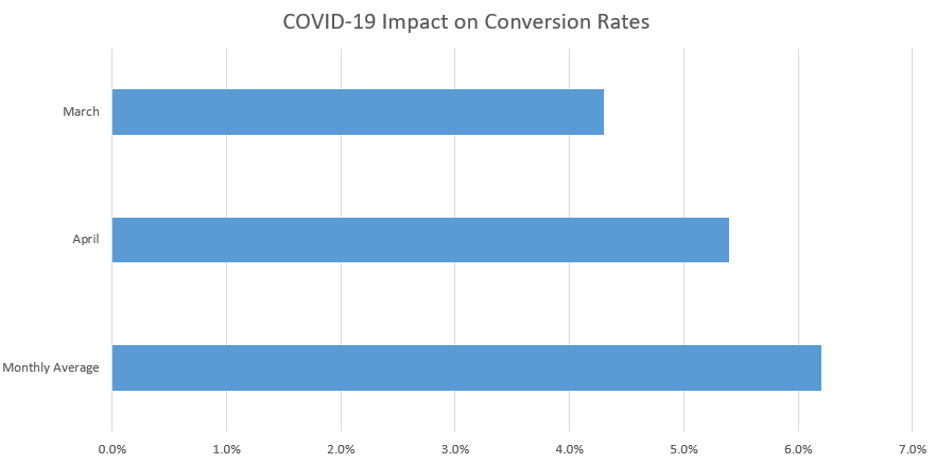
he main takeaway is here is not to be discouraged. Even if your marketing efforts take a hit right after a crisis, you can expect your metrics to bounce back as life starts to return to normal.
In addition to being patient, don’t underestimate the importance of staying organized. If you get a response from a webmaster saying they will review your website in the future (after the pandemic calms down a bit), make a note to remind yourself to follow up after a certain amount of time. We recommend keeping follow-up emails short and sweet. Acknowledging that you know your recipient is busy and briefly restating how your offer can help their site visitors can go a long way.
What Our Team Learned While Building Links During COVID-19When the pandemic first hit, most of us on the Investis Digital link development team assumed that this was bad news for our link-building campaigns.
However, by coming together to brainstorm new strategies for our clients, we were able to shift our efforts, largely focusing on building links to client content that was hyper-relevant for the current state of the world. In most cases, we were working with content that was published before the pandemic, so we had to channel some creativity in terms of how we phrased our outreach emails and pitched our client’s resource.
One example comes from a client in nursing education who has a piece of content on their site discussing blood donations in times in crisis. Our team was able to build nine links to this piece in the month of April 2020, all of which were earned on pages specifically dedicated to COVID-19 resources—even though our client’s article was published before the pandemic and made no mention of the virus.
For a client in the higher education industry, we noticed a trend among March and April 2020 data that illustrated a notably higher success rate when pitching content relevant to the pandemic. Relevant content included blog articles discussing online learning tips and strategies for remote learning.
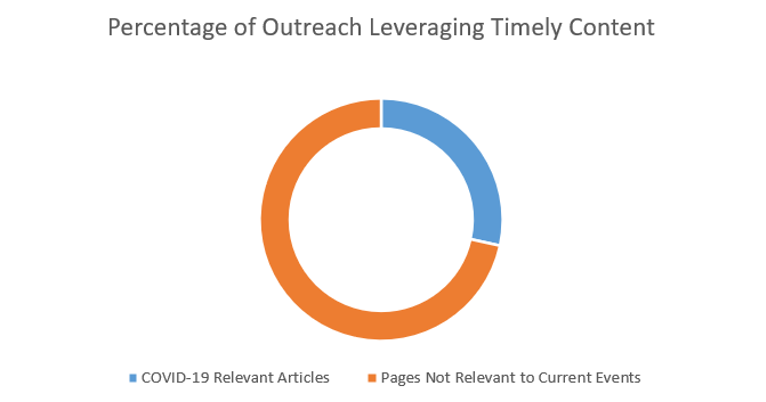 Although only about a third of our total outreach emails sent for the client during this time period were for articles relevant to COVID-19 (largely because we didn’t pivot our efforts until late March), our conversation rate for COVID-19 relevant articles was impressive — 6.3% as compared to 4.1% for all other pages. And in April 2020, 22 out of the 44 links we built for this client (50%) were for blog pages providing tips for students participating in online learning.
For us, trying to build links in times of crisis has reinforced the importance of offering webmasters resources and articles that are actually relevant and helpful for their visitors. Link building is already widely associated with spam or black-hat tactics—help switch the narrative by driving links to content that provides real value to readers.
In addition, these difficult times have taught us the importance of adaptability when it comes to link building and other aspects of digital marketing. If we had continued with business as usual instead of purposefully shifting our efforts to content that addresses timely and newsworthy topics, our campaigns surely would have taken a noticeable hit.
If you are struggling to earn links to your website right now, we encourage you to reassess your tactics and look for areas where you can adjust your strategy to better align with current events. It may take a bit of ingenuity and perhaps the creation of some new content, but these changes can really make a difference in your campaign's success.
Download Our New Guide
To learn more about the value of link building and SEO, please download our newly published guide, How to Build Quality Backlinks that Impact Organic Visibility . Read this guide to understand why links are crucial for ranking #1 on Google.To learn more about Investis Digital’s SEO expertise and experience, feel free to contact us at any time.