
What Does Facebook’s 2021 Growth Mean for Businesses?
Facebook had a bonkers first quarter. The world’s largest social media network smashed investors’ expectations for both earnings and revenue growth, continuing a strong pattern of growth throughout the pandemic. If you are one of many businesses that include Facebook in your brand-building tool kit, what does Facebook’s success mean to you? Here are three takeaways:
1. Your Potential Audience Is Getting Bigger
Facebook continues to increase its monthly average user count. As of the first quarter, Facebook has 2.85 billion monthly average users. As CNBC reported, and revealed in their graph below, that growth continues year over year, going back before the pandemic triggered a surge in social media usage:
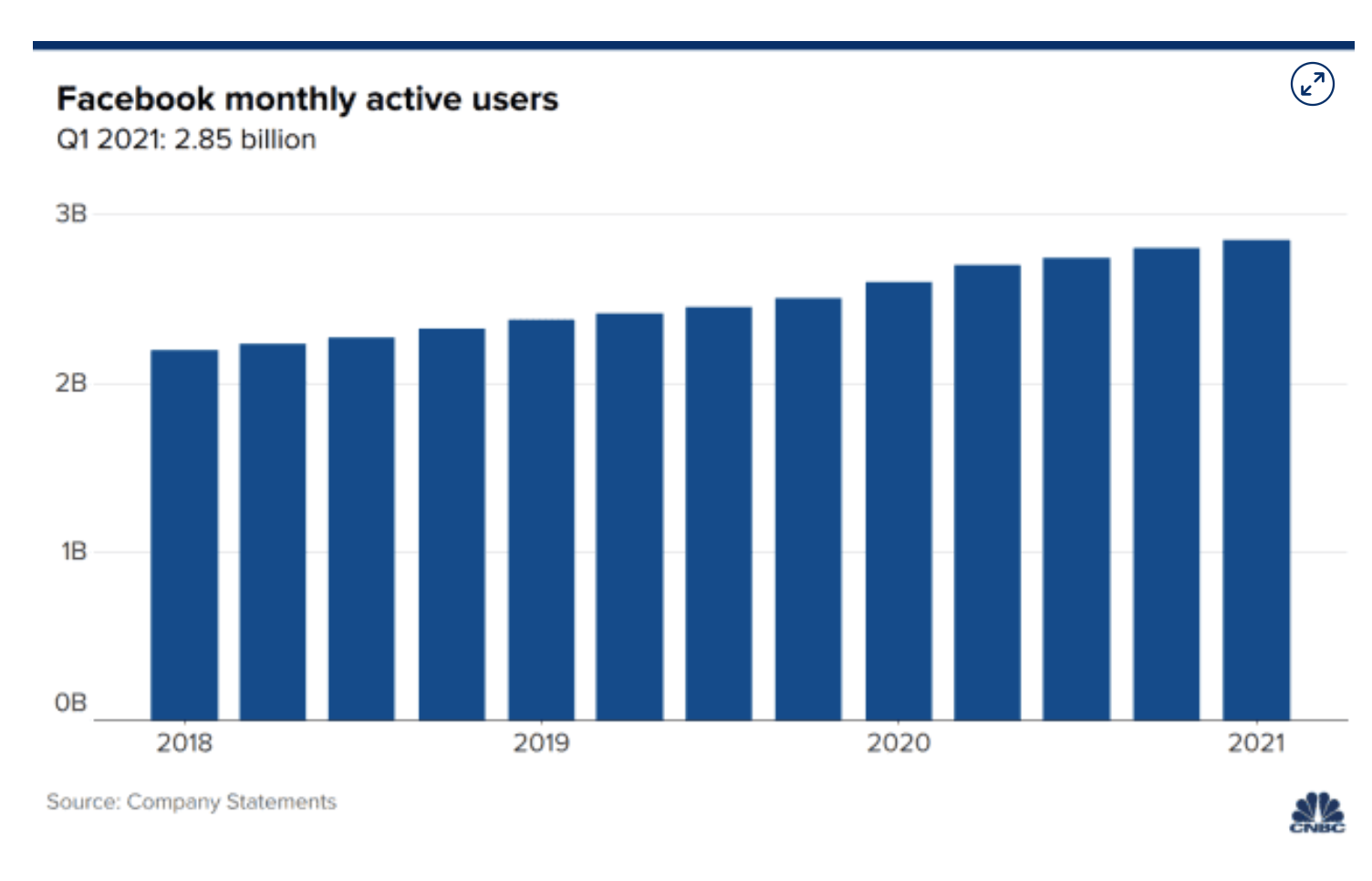
So as businesses start to see a light at the end of the tunnel with the pandemic, you should assume your audience on Facebook will grow.
2. Facebook Will Continue to Find New Tools to Help You Engage with Your Audience
The days are long gone with having a presence on Facebook meant nothing more than posting content on your feed and responding to users. It’s still very important to do those things, but Facebook continues to find new tools to help you engage with your audience. For instance, in his quarterly conference call with investors, Facebook CEO Mark Zuckerberg discussed how Facebook is making big strides with virtual augmented reality and augmented reality.
“I believe that augmented and virtual reality are going to enable a deeper sense of presence and social connection than any existing platform, and they're going to be an important part of how we'll interact with computers in the future,” he said. “So we're going to keep investing heavily in building out the best experiences here, and this accounts for a major part of our overall R&D budget growth.” He noted that Facebook has launched a tool so that people can subscribe to services like FitXR to do boxing and dancing in VR just like they would for biking on Peloton.
When a bellwether company such as Facebook makes augmented reality and virtual reality an important part of its growth strategy, it’s important to consider how your own brand storytelling approach might incorporate these immersive technologies. In addition, as we have blogged, Facebook is rolling out tools to make audio technology a more prominent part of the social experience.
3. How You Amplify Your Narrative on Facebook May Change
Facebook’s growth was driven by a 30 percent year-over-year increase in the average price per ad and a 12 percent increase in the number of ads delivered. But Facebook’s growth might be facing some headwinds, in the words of Chief Operating Officer Sheryl Sandberg. That’s because Apple’s iOS 14.3 operating system gives iPhone users more control over their data by allowing them to decide how advertisers can track them. Under iOS14.3, users of iPhones will now need to agree to allow a business to collect information about them, known as an opt-in policy. Data that has historically been used to target users and improve algorithms may now be limited, which could have an effect on the performance of digital advertising on Facebook. We blogged about the potential impact of iOS14.3 back in January. Facebook is bracing for a decline in advertising performance caused by users possibly blocking Facebook from tracking their activity across the web thanks to the new Apple feature.
No one really knows what the long-term impact will be. But Facebook needs to answer to shareholders, and that means being transparent about potential risks and threats to its business, which is why Sheryl Sandberg cautioned investors about headwinds as the impact of iOS14.3 is felt. None of this means advertising is going to disappear from Facebook – far from it. Sandberg discussed some interesting developments in Facebook’s ad products. For instance, she said Facebook is seeing strong growth in Stories ads and video ads, and Facebook is seeing “strong growth” across ads in Facebook Watch, which now has more than 1.25 billion people visiting every month.
She said on Facebook’s Earnings Call, “As the number of people watching video grows, we’re developing more opportunities for businesses and creators to reach them. We’re expanding Paid Online Events to more countries. We’re enabling more people to run in- stream ads, including in Live videos. And we’re developing ads in short-form videos, where we’re testing the ability for content creators to monetize their Facebook Stories with ads that look like stickers.”
This is no time for advertisers to panic. Will advertising become less personalized on Facebook? It sure looks like it. But watch for Facebook to find creative solutions to bring in revenue from advertising – which means Facebook will remain an important destination for amplifying your message. In fact, Facebook is catching up to Google in terms of online advertising marketshare, according to eMarketer. Meanwhile, as we blogged in January, we do recommend you monitor your ad performance on a regular basis to understand the effect of these changes, especially for segments involving iOS users.
Contact Investis Digital
To amplify your narrative across paid, earned, and owned media, contact us. With our Connected Content approach, we are well positioned to help your business grow in a digital-first world.