

Google and Microsoft Launch AI Search Arms Race
Within 24 hours of each other, both Google and Microsoft officially declared that they are embedding conversational AI into search.
On February 7, Google/Alphabet CEO Sundar Pichai published a blog post announcing the launch of Bard, which will function as a chatbot to assist people seeking information in Google Search. Bard is viewed as a direct answer to the popular ChatGPT tool that OpenAI made public in November 2022.
Not to be outdone, on February 8, Microsoft announced that it is formally integrating conversational AI inspired by ChatGPT into Bing Search and the Edge browser. This was not a surprise. Microsoft is a major investor in OpenAI. It was widely reported that a ChatGPT/Bing integration was forthcoming (and we had something to say about that on our own blog). In a message in its search engine, Bing states that its new chat-mode is only available via access to the new Bing – it's available only through waitlist currently. But, you can play with the new Bing in preview mode on Bing.com.

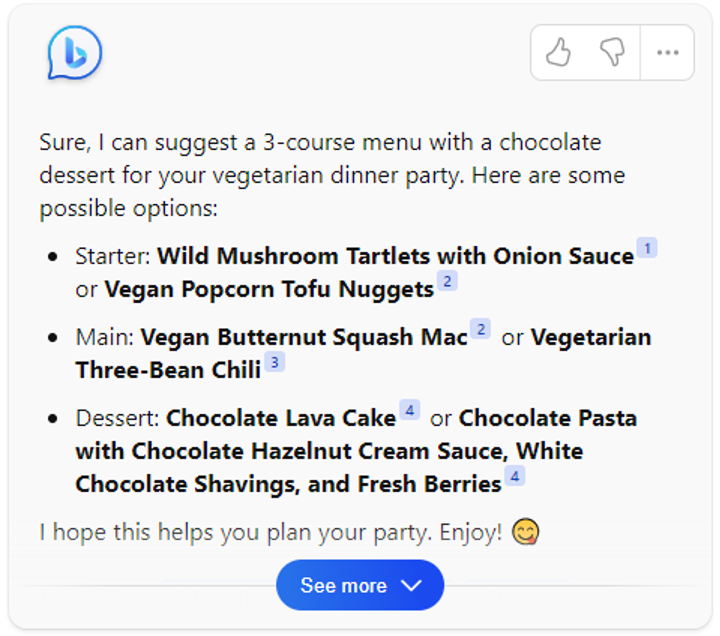
Although Microsoft didn’t quite integrate with ChatGPT as we know it, the company incorporated “a new, next-generation OpenAI large language model that is more powerful than ChatGPT and customized specifically for search. It takes key learnings and advancements from ChatGPT and GPT-3.5 – and it is even faster, more accurate and more capable.”
Both Google and Microsoft stressed that their conversational AI interfaces will do more than provide answers to questions. Rather, they’ll help people do everything from write an email to plan vacations.
Sundair Pichai wrote that “Bard can be an outlet for creativity, and a launchpad for curiosity, helping you to explain new discoveries from NASA’s James Webb Space Telescope to a 9-year-old, or learn more about the best strikers in football right now, and then get drills to build your skills.”
Yusuf Mehdi, Microsoft’s Corporate Vice President & Consumer Chief Marketing Officer, wrote that Bing will provide a “creative spark.” He explained:
There are times when you need more than an answer – you need inspiration. The new Bing can generate the content to help you. It can help you write an email, create a 5-day itinerary for a dream vacation to Hawaii, with links to book your travel and accommodations, prep for a job interview or create a quiz for trivia night. The new Bing also cites all its sources, so you’re able to see links to the web content it references.
Google is vetting Bard with a team of reviewers to mitigate against problems such as bias and inaccuracy sabotaging the Bard search experience – which is notable because conversational AI continues to be plagued with accusations of being biased and flat-out wrong.
So, take a deep breath everyone. The galvanizing conversational AI tool ChatGPT from OpenAI has been open for public use for just over two months – and look how much impact it has had already. To be sure, both Google and Microsoft have been investing in various forms of AI for years. But clearly, they were forced to play their hands by OpenAI. (And of course, Microsoft, being an investor in OpenAI, had good reason to build up OpenAI’s profile.)
What this means for Big Tech: they’ve reached the point of no return with conversational AI. So much of the discussion about conversational AI has focused on ChatGPT either helping or hurting creators. This discussion is not going to go away. Now we are going to see a shift in the dialogue toward the impact of ChatGPT and its competing models influencing search. Apple and Amazon will surely be speaking up soon – especially given how Amazon is the most popular search tool for products. We are very curious to see what types of queries are the most affected and what the impact is for brands. More on that later.
What businesses should do
My advice remains unchanged since I wrote about this topic on January 10:
- Absolutely experiment with conversational AI, but be aware of its shortcomings – especially the lingering concerns about bias and wrong information hurting the search experience.
- If you are an advertiser on Google and Bing, pay very close attention. One of the open questions about conversational AI is how it will affect paid search. Conversational AI tools flourish by giving searchers detailed responses instead of links to other sites. But the success of paid search on both Google and Bing depends on people staying engaged on Google Search and Microsoft Bing clicking on links. Now is a good time to talk with your Google and Bing account representatives.
Meanwhile, head on over to Bing.com and join the waitlist for its chat-enabled search. And be ready for what Google unveils when Bard is public.
Contact Investis Digital
To learn more about how Investis Digital can help you improve your brand via search, check out our expertise. If you have questions about how Investis Digital can help your brand improve customer engagement in organic search, please reach out.