

Running Successful Events, Virtually
As the disruption of the COVID-19 pandemic continues, businesses everywhere have quickly pivoted their approach to running meetings and events – ranging from investor presentations to employee events.
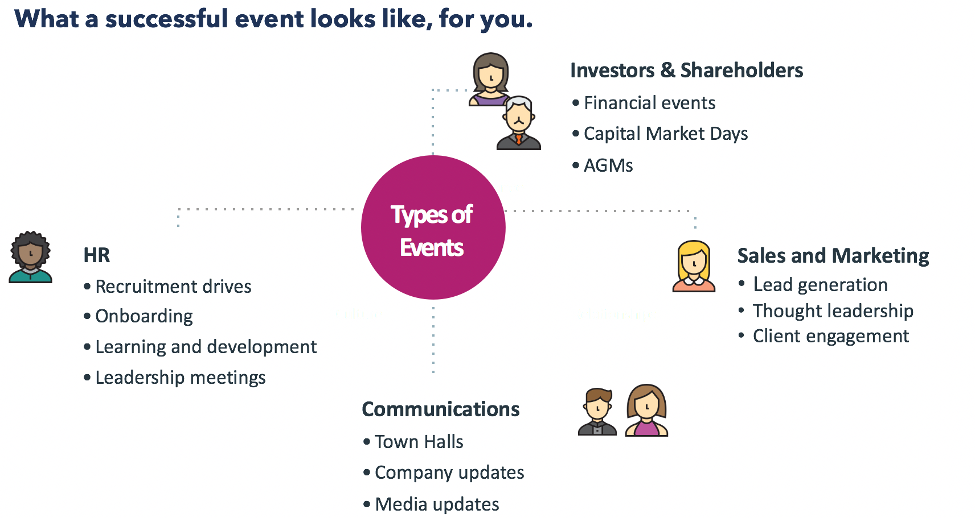
During the recently conducted Investis Digital Connected Content week – itself an offline event that went virtual in 2020 – I, along with Frank Persia, discussed some key steps and tips for getting the most out of your virtual event. Here are some highlights.
The Importance of “Why”?
All events, online and offline, begin with a clear objective. It’s an obvious but often overlooked question to ask especially if you are taking an offline event online. What is the purpose of holding the event in the first place – to generate leads? Inspire employees understanding of the “Why” that drives every decision you make.
Who Is Your Audience?
Of course, any effective event should be rooted in a thorough understanding of your audience. In addition, a virtual event presents an opportunity to extend the audience in ways that might not have been possible within the constraints of an offline event. Even still, make sure you ask the hard question of why your audience should attend. Keeping your audience at the center of your plan is especially useful for making decisions about content and engagement tactics.
Measurement
One of the amazing benefits of a virtual event is access to online data. With the right analytics, you can understand quickly answers to important questions such as, what worked with the event? What did not? What needs to be improved? Measurement also helps you with the tactical execution of an event ranging from registration levels to actual attendance.
For IR and comms teams, measurement will likely focus on the registration process and engagement levels. Sales/Marketing will need consider longer-term lead generation goals.
Content
Content is the Number One factor for making an event succeed. You can have all the right planning and strategy in place, but if your content is bad, you won’t keep people interested.
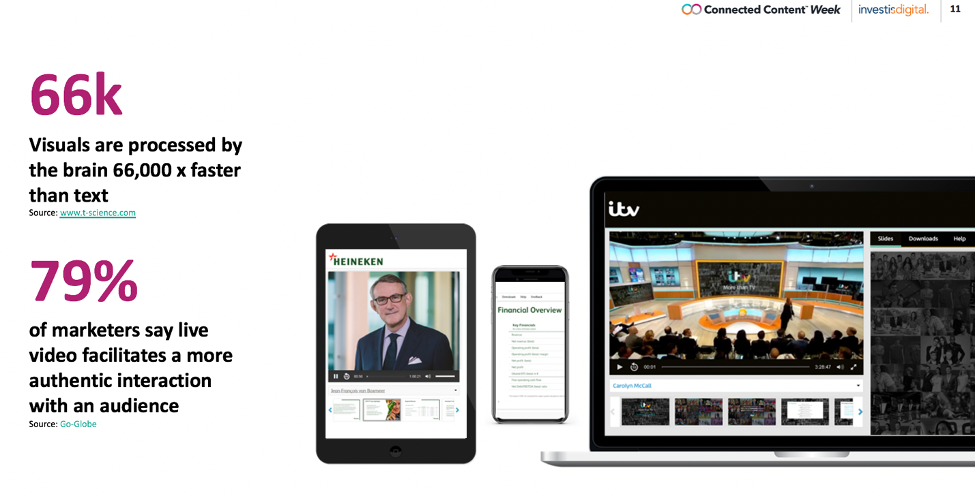
Remember that you will be engaging people on a screen – likely for people who are easily distracted. Consider easily consumable content that is exciting and engaging such as video.
Video, if done right, works exceptionally well. And with a virtual event, you can achieve massive benefits of pre-recorded video. With pre-recorded video, you bypass the stress and risk of live video and focus on content.
What Experience Do You Want to Create?
The experience is an essential element that overlaps with technology considerations. The type of experience you want to deliver goes hand in hand with your desired objective. For instance:
Broadcast
This is a one-sided format that might be ideal for an educational presentation in which audience interaction is not important. A recorded webinar might work just fine.
Engagement
Engagement means giving attendees some form of participation, examples being offering polling and Q&A options. With a simple engagement approach, you want to give people a way to interact without opening up the floor for a conversation – ideal, for instance, when you are on a tight time frame.
Interaction
An interactive event means providing two-way dialogue. Providing interaction is often ideal for investor relations events in which a managed dialogue is expected.
Collaboration
With collaboration, you allow multiple people to be in a room for brainstorming – say, in a leadership team meeting or in a breakout session. These events employ collaboration tools in formats ranging from leadership events to breakout sessions in events.
Networking
This is a huge opportunity for virtual events, and one that the industry is still figuring out: encouraging one-on-one sessions and opportunities for people to meet other people in context of a virtual event.
Technology
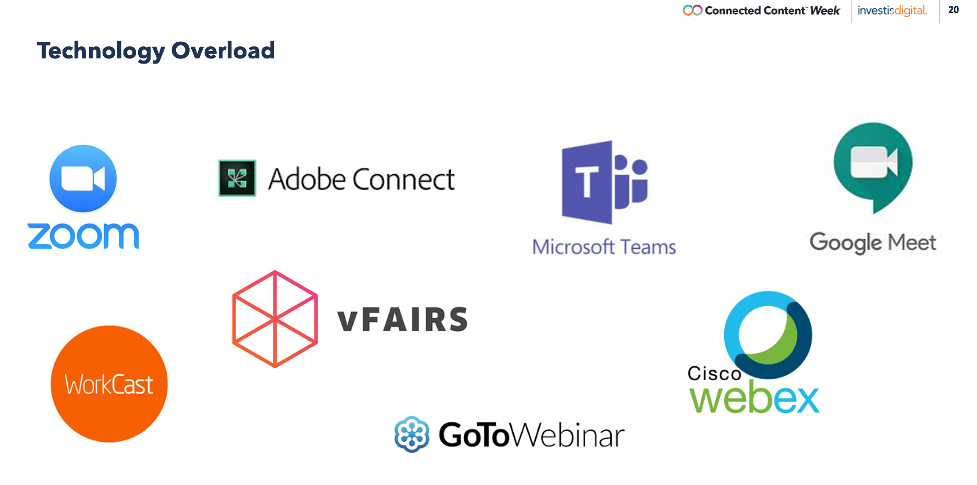
It’s getting harder and harder to sort through all the platforms available for hosting an event now. There are a ton of webinar platforms including self-service platforms such as Teams and full-service providers. How to decide?
Several factors come to mind, ranging from security and the experience you want to provide. Security is a big factor. It’s one of the most important considerations, as we have seen with news stories about people hacking Zoom.
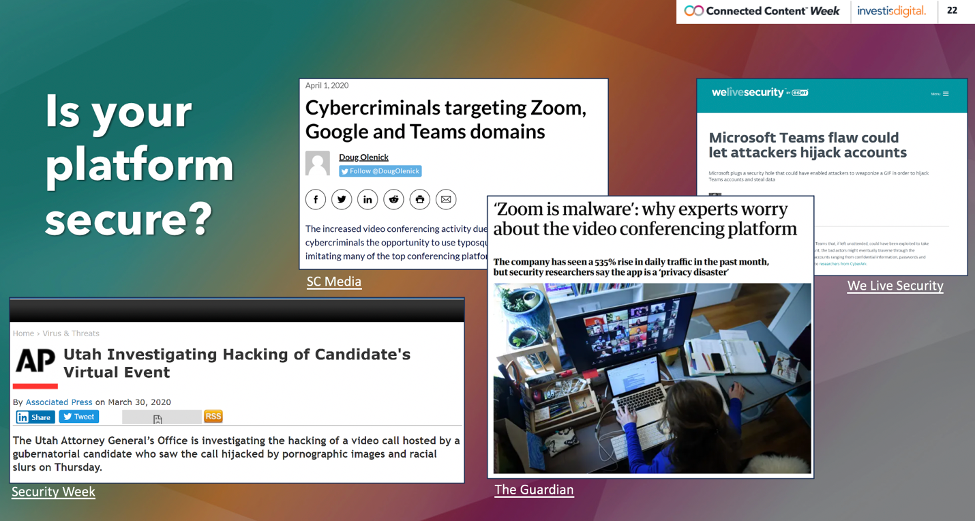
At Investis Digital, we have security protocols in place. We randomize URLs so that people cannot guess them. We also provide platform and firewall protection.
Knowing what features are available is also key. Some features include screen sharing, video options, and the ability to see speakers with Webcam. These decisions flow from your strategy and desired engagement level. When you know what kind of event you want to provide, the decision about features (and the platforms that support them) become easier.
The Importance of the Presenters’ Experience
Your platform needs to give the presenter a good experience. For example, having a unified interface to log into gives the speaker the ability to see all chat activity and answers to polling questions occurring during a presentation. If you give the presenter too many log-ins, they get distracted. You want to make it as easy as possible so that the speaker can focus on content.
The Attendee Experience
You want attendees to have as good or even better experience virtually than they can get offline. Does the format mimic the in-person meeting? Are they being exposed to the right materials? Is it easy to log into the event? This is a crucial question and not as easy as you think. People want a simple link no matter what device or browser.
Moderators and Event Managers
What will their experience be like? How can you simplify them? Here is where a project manager from a vendor is key – someone who knows the terrain and will ensure you have all the correct features. With self-service platforms you do not get that kind of support.
Download Our Guide
For more information on mastering a virtual event, download Guide on Webinars, Webcasting and Virtual Events. This guide provides you with all the insights you need to create close emotional bonds with your audience at scale, get high attendance and engagement, faster and more cost efficiently than you would with an offline event.